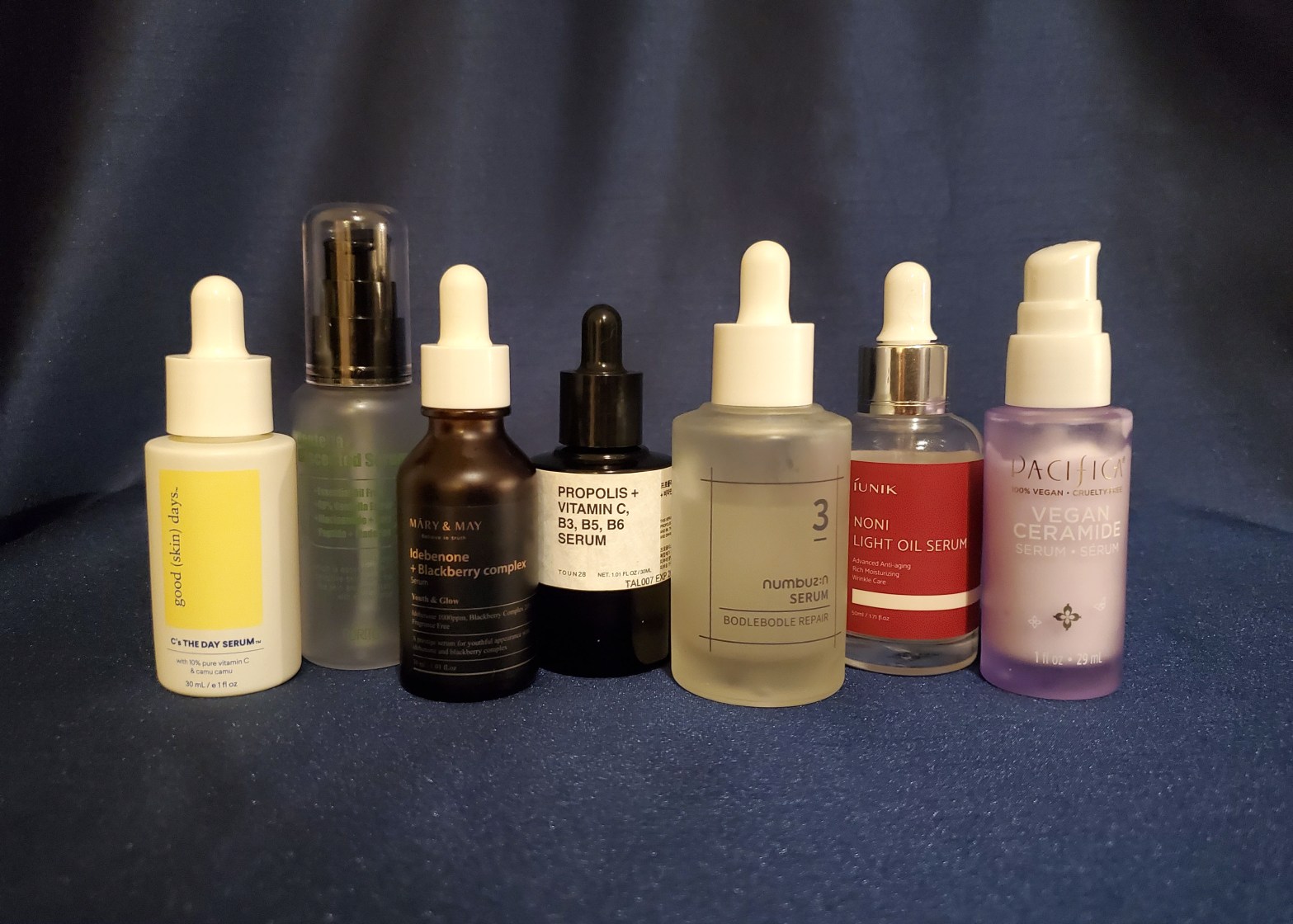
I’ve been crushing on my serum line-up lately. A nice “serum stable” is eminently shelfie-worthy and so important as you learn to listen to your skin, but building one out is where so many skincare newbies go wrong and where so many skincare fanatics can go overboard. So let’s discuss.
A few notes before we get into it:
- While I use exfoliating acids, retinol and ascorbic acid, I’ve excluded those treatment serums from this post since routines and rotations with those tend to be very specific to what your skin can tolerate.
- All the various serums and categories of serums I’m about to discuss can theoretically be layered with any actives, though as with all skincare, your mileage may vary.
- Not all skin can take a lot of layers, and not all wallets can take a lot of serums. At the end of the day, a good skincare routine is one that leaves you, your skin and your financial situation healthy and happy.
❔What is a Serum? And How do Ampoules and Essences Fit In?
The typical definition of a serum is something like “a step between cleansing and moisturizing that focuses on delivering high concentrations of active ingredients to the skin” but I always feel like that lacks nuance, and can leave you thinking that only, say, lactic acid serums qualify as serums. Rather, serums typically focus on one skin concern, or delivering one set or category of ingredients: think the ever-popular The Ordinary Niacinamide 10% + Zinc 1% Oil Control Serum, or many folks’ first k-beauty serum Purito Centella Unscented Serum. Ampoules like the Cosrx Propolis Light Ampoule also fall into this category, and many folks use essences like the Benton Snail Bee High Content Essence as serums as well.
My “is this a serum” rule-of thumb? Thicker than a toner, lighter than most moisturizers, basically always in a dropper or pump bottle, usually found in 30 mL sizing though occasionally in 50 mL and, once in a great while, in 100 mL sizes. Can be watery, jelly or lightly creamy in texture, but a pea-sized amount is enough to cover face, neck and chest. Ampoule and essence are both codewords for “it has a lot of this in there” so depending upon your opinions about viscosity, they all fit into the serum stage of your routine.
🤔 Thinking in Skin Concerns and Ingredients
It can be easy to get caught up in hype and sales and just buy things for the sheer pleasure of buying things, or because someone you trust (maybe even me!) said something was a must-buy. But there are a lot of serums in the world, and you must not and cannot buy them all.
Serums are really intended to help with a skin concern. You may have multiple skin concerns, but it’s best to pick one skin concern (and one serum to help it) to start. It takes a while to see results, depending upon the skin concern — usually at least four weeks — and while you’re nailing down your serum stable you really want to know how each serum is affecting your skin.
🛣 The Intersection of Skin Concerns and Skin Type
Once you’ve picked a skin concern to focus on first, you have to research serums that not only address that concern, but also work for your budget and skin type. I frequently see folks buying serums well out of their budget because they’re the ones that they’ve heard about that treat the issue (e.g. the $49 USD / 30 mL Dr Jart Cicapair Tiger Grass Serum for redness), or buying serums that might treat the issue but not for their skin type (e.g. the above-referenced The Ordinary Niacinamide 10% + Zinc 1% Oil Control Serum, which is almost always a no-go for dry skin types, even if niacinamide is good for evening skin tone).
So many new products have launched or become more globally accessible in the past few years that you can definitely find something that will work for your skin concern, skin type and budget. Finding influencers with a similar skin type certainly helps, since their reviews will align with your needs. Googling for ingredient recommendations and asking for help in groups like Skincare Fanatics can help create a list of products to try, and get reviews on how those products worked.
🦸♀️ Narrowing Down to Hero Ingredients
As you’re researching your skin concern, you’ll definitely run into lists of ingredients to treat it. For example, I recently wrote about the Best K-Beauty Products for Redness Reduction, which highlighted the hero ingredients in each product. Not all ingredients will necessarily help how the skin concern manifests for you — mugwort, for example, has never helped me fight redness — which is why experimenting might be necessary. The first serum you get to address your skin concern won’t necessarily be The One, but you have to give it plenty of time to work (I personally recommend emptying every skincare product you buy before moving on, unless it’s irritating your skin).
As you try more serums, you’ll notice themes in what works for you. By checking out the ingredient lists in what you’re trying and cross-referencing with what can help your skin concern, you can figure out what to look for in other products. For example, I noticed huge boosts in glow from the iUNIK Propolis Vitamin Synergy Serum, so I moved onto other propolis serums until I found my HG Some By Mi Propolis B5 Glow Barrier Calming Serum, which not only has the propolis for glow, but other favorite ingredients like panthenol and ceramides. Finding these favorite ingredients enables you to experiment constantly with specific skincare products without ever doing your face a bamboozle, because you’re always using the same set of ingredients you know it likes.
🔄 Rotating and Layering Serums
Once you’ve found a few serums for your skin concerns, or are combining them with those otherwise-excluded-from-this-post actives, it’s time to make them work together in a routine. I tend to try to use most of my serums in every routine, but depending upon the rest of your routine, your skin type and even your specific sunscreen/makeup habits, that might be a non-starter. So what do you put in each routine, if it can’t be everything, everywhere, all at once?
☀️ AM Routine
The AM routine is typically all about protection — after all, the most important step of it is sunscreen. This is where you’ll also want your antioxidant serums. For many folks, this is a vitamin c serum — whether ascorbic acid itself, or any number of derivatives. But it can also be the non-exfoliating-acid, non-retinol serums that you’ve introduced specifically fight sun damage, for example. The goal here is to use your sun damage and pollution damage preventative steps here.
The AM routine is also an excellent time to add hydration. Since hydrating serums tend to give an instant appearance boost, you can feel like your best, dewiest self by adding a peptide or hyaluronic serum — if, of course, hydration is a concern.
I recommend doing your AM routine thinnest to thickest, with your ascorbic acid serum (if you use one) first. I always recommend doing a damp skincare routine, but definitely be sure to apply your hydrating serum on damp skin. That said, I recommend putting a step between your ascorbic acid and any peptides, so as not to denature them. And be careful with layering up too many serums, as this may cause your moisturizer or sunscreen to pill up and ball upon application.
🌜 PM Routine
After a long day, the PM routine is all about rebuilding the skin. Along with any exfoliating acids or retinol you may be using (in the same routine, or not — you and your skin do you), this is a great time for any skin barrier supportive ingredients like ceramides or prebiotics/probiotics/postbiotics. Especially when using strong actives, these can help reduce the irritation in a routine.
This is also a great time to use any oils masquerading as serums (a common thing in the Western market), or the serums that might have caused pilling in your AM routine. Since you don’t have to worry about how you look, you can slather it on and look as greasy or pill-y as you need to look, all without worrying about the efficacy of your sunscreen.
Much like your AM routine, I recommend doing PM routine thinnest to thickest — but it can get more complex for PM. I recommend doing your exfoliating acids first in your serum step, so your skin can be dry, if needed, to reduce irritation. After exfoliating acids, do your water-based serums. Then do your oil-based serums. I personally believe in putting your retinol last, so your skin is well buffered. (Incidentally, this is also how I can get away with using both in a routine).
😉 How I’m Doing My Serum Step Lately
I’m using the serums pictured above on a daily basis — no retinol or exfoliating acids shown, since at the moment I’m not using them in serum form.
Typical morning: Good Skin Days C’s The Day Serum; Mary & May Idebenone + Blackberry Complex Serum; Purito Centella Unscented Serum
Morning when I’m feeling fancy: Good Skin Days C’s The Day Serum; Mary & May Idebenone + Blackberry Complex Serum; Toun 28 Propolis + Vitamin C, B3, B5, B6 Serum; Purito Centella Unscented Serum; numbuzin No. 3 Skin Softening Serum
Typical evening: Purito Centella Unscented Serum; Toun 28 Propolis + Vitamin C, B3, B5, B6 Serum; numbuzin No. 3 Skin Softening Serum; Pacifica Vegan Ceramide Serum
Evenings when I’m feeling fancy: Purito Centella Unscented Serum; Mary & May Idebenone + Blackberry Complex Serum; Toun 28 Propolis + Vitamin C, B3, B5, B6 Serum; numbuzin No. 3 Skin Softening Serum; iUNIK Noni Light Oil Serum; Pacifica Vegan Ceramide Serum
 Lisa Loves Skincare
This is so well-written. I love how when discussing the routines you wrote this… “AM is for protection” while, “PM is for rebuilding of the skin”👏🏽
LikeLiked by 1 person
Thanks! I think it helps to give each routine a focus — otherwise folks try to do too much all at once (and I say that as someone with a big routine!)
LikeLiked by 1 person