June Empties Reviews

Hello again! It’s been a while. We went on a 2.5 week “working roadtrip” and I had truly intended to continue writing, since part of the goal was to see if we could manage a “digital nomad” lifestyle while keeping up with our day-to-day. Suffice it to say that making travel days on weekends kind of bamboozled that, and who wants to do the thing you can do anytime when there are exciting new hikes to do? Along with sliding off the writing bandwagon during the trip, I admittedly also shirked a bit on skincare, and I can tell. My pores are showing a bit more and there’s some new sun damage (the tiny home we stayed in with plexiglass for a roof probably didn’t help on that front, though more to come on that in a future post).

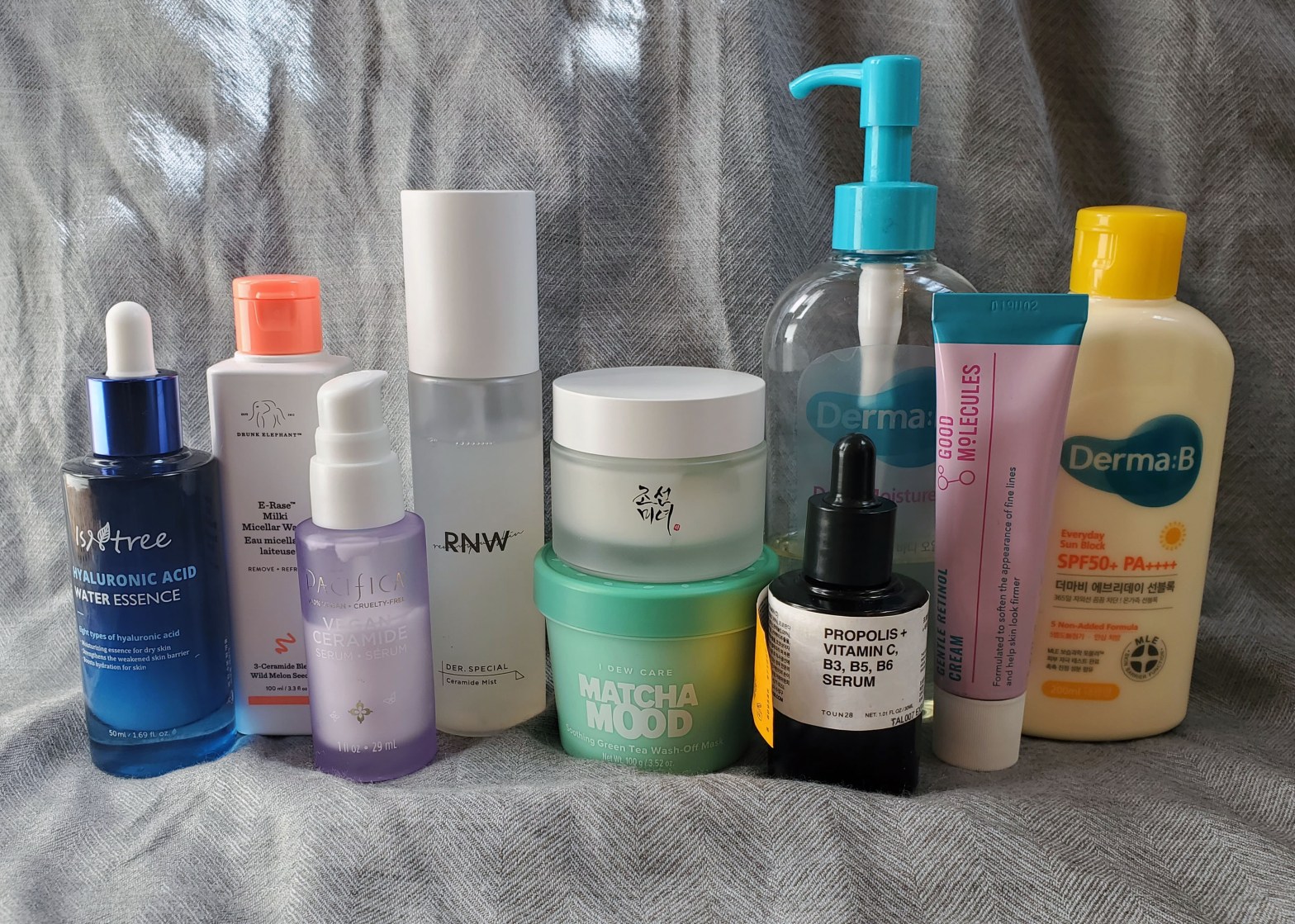
This post should probably include about four more products than it does but they’re not quiiiiiite empty, so prepare to judge me in my July empties. In the mean time, here’s what I stopped putting on in June. A lot of it was “pretty okay, but knock-it-out-of-the-park” level, as evidenced by the 8/10s. Fun fact: you can really see how it takes me two months to empty a serum in this post.

Wash-Off Products

🍷 Neogen Bio-Peel Gauze Peeling Wine Pads

The Neogen Bio-Peel Gauze Peeling Wine Pads used to be a much-hyped product, so when I won a $100 skincare haul through Nudie Glow US last summer I picked it up. And then they sat in my stash. And then I opened them. And then they sat on my counter taking up WAY TOO MUCH SPACE. These are fairly large physically and chemically exfoliating pads infused with red wine extract and resveratrol for antioxidant benefits, as well as glycolic and lactic acid. They are decently exfoliating but, that said, these are intended to be washed-off, so you don’t really get the antioxidant benefits. I used these predominantly in the morning when I wanted a bit more of a cleanse feel without actually cleansing. The pads are fairly large so if you are the type who likes disposable exfoliants, I recommend cutting them in half as that’s more than enough product to get decent coverage, and of course makes them last 60 uses rather than 30.
Opened: January
Price: $27 USD / 30 pads (200 mL)
Rating: 3/10

🍵 I Dew Care Matcha Mood Soothing Green Tea Wash-Off Mask

I Dew Care’s zone of genius is definitely masks, whether sheet- or wash-off, and their Matcha Mood Soothing Green Tea Wash-Off Mask is a prime exemplar. This is the sort of creamy, moisturizing mask that used to be impossible to find at any price lower than “an arm and a leg” and includes green tea extract, CBD oil, aloe extract, centella asiatica extract, heartleaf extract and chia seed extract, which are all soothing ingredients. I Dew Care has super cute branding, both in packaging and in actual product aesthetics — this, for example, is as green as the container. (Spoiler alert: their blue mask, which I just opened, really looks like frosting.) They run regular deals both through Ulta and YesStyle — for example, I actually got this mask for free during the latter’s Black Friday sale, though I had tried the small size initially to know I liked it. This mask rinses fairly cleanly, and I recommend it as a way to protect your skin in the shower.
Opened: April
Price: $25 USD / 100g
Rating: 8/10

Serums

💧 Isntree Hyaluronic Acid Water Essence

If you’ve been reading my content for a while, you know that hyaluronic acid is not my friend. Between my sensitive cheeks and living in a state so dry they’ve stopped referring to us as being in a drought and started referring to it as aridification, there seems to be no way for me to consistently use hyaluronic acid-focused products without it irritating my skin. Unfortunately, that streak of bad luck continued with the Isntree Hyaluronic Acid Water Essence. This essence, which is truly really a serum, uses a variety of molecular weights of hyaluronic acid, as well as niacinamide, panthenol, and a variety of plant extracts. “Why did you get a hyaluronic acid serum, Lisa, if they don’t work for you?” Well, funny story, but I got it for free in a giveway and I am not one to turn up my nose at free skincare. I will use it all up, come heck or high water. In this case, when not even slugging my cheeks with Vaseline could save them, I downgraded this to body care. I will say I actually loved it as a body serum — rub it into damp skin after the bath, throw on said Vaseline over top and you will be soft and silky. At 50 mL it’s arguably feasible to use this way, but I don’t think I’ll be rebuying for that purpose because it’s just a bit too fussy to bother.
Opened: April
Price: $31 USD / 50 mL, though frequently cheaper on some retailers
Rating: 5/10

🐝 Toun28 Propolis + Vitamin C, B3, B5, B6 Serum

Another thing you’ll be aware of if you’re a long-time reader is my love of propolis (fun fact: my most read post is my Face Off of the Propolis Serums: iUNIK vs COSRX vs Beauty of Joseon), and I can’t resist the urge to try out new propolis serums. Enter the Toun28 Propolis + Vitamin C, B3, B5, B6 Serum. Toun28 is a k-beauty brand that’s still relatively unheard of, but is making waves due to their approach to low-waste packaging (their moisturizers literally come in biodegradable paper, while their serums come in glass with rip-off labeling to promote recycling). Propolis, which is a bee byproduct, has been a favorite ingredient of mine for almost two years for increasing glow and reducing breakouts. This serum includes 88% propolis extract, plus 2% ascorbyl glucoside (a vitamin C derivative), 1% niacinamide (vitamin B3), panthenol (vitamin B5) and pyridoxine HCl (vitamin B6), to hit on all the ingredients in the name. In proper k-beauty fashion, it also includes a variety of plant extracts which gives this a pleasant fragrance without adding any explicitly fragrant components. This is a very lightweight, non-sticky propolis serum that I find to be quite elegant, and makes me excited to try more from the brand.
Opened: April
Price: $35 USD / 30 mL
Rating: 10/10

💜 Pacifica Vegan Ceramide Face Serum

Much like propolis, I also have a hard time turning away from ceramide serums, so after Pacifica, a “clean” drugstore brand, released their fragrance-free ceramide line, I had to try their Vegan Ceramide Face Serum. Ceramide serums tend to either come in “hydrating”, “goopy” or “oh hey I’m actually an emulsion” textures, and this one is definitely in the emulsion camp. Because of this, it comes in a pump bottle which is fairly nice to use until the bottom 25%, at which point it becomes frustrating because the pump stops working very well.T his includes ceramides NP, AP and EOP, as well as ceramide precursor phytosphingosine, plus cholesterol, fatty acids and some plant extracts. There are other ceramide serums I prefer but given how expensive they are to formulate with, it’s great to find something more accessible that can help rebuild and support the skin barrier.
Opened: April
Price: $16 USD / 29 mL
Rating: 8/10

Other Skincare

🌊 Round Lab 1025 Dokdo Toner

As a hydrating toner aficionado, I was excited to try the Round Lab 1025 Dokdo Toner. Round Lab is a k-beauty skincare brand with a whole line called Dokdo, which is a contested group of islands predominantly claimed by Korea but also by Japan and North Korea (its history is actually pretty interesting if you want to read up on the Liancourt Rocks). The reason for the name is the use of seawater from the area, which this toner makes great use of. While sea water can be drying in the wild, it’s also full of minerals which are good for the skin. This toner also includes panthenol and allantoin for soothing, as well as a smidgen of an enzyme which provides light exfoliation. Despite that enzyme, this has a light texture that layers up nicely both AM and PM for those interested in the seven skins method, all without feeling a bit stripping like other lightly exfoliating k-beauty toners can.
Opened: March
Price: $17 USD / 200 mL
Rating: 9/10

👄 Rohto Mentholatum Melty Cream Lip Matcha Lip Balm SPF25 PA+++

Need a lip spf? Hate the flavor of chemical filters and the white cast of mineral filters? Want something relatively cheap because you’ll inevitably run your chapstick through the wash? Well, you need Rohto Mentholatum. Their Melty Cream Lip Matcha Lip Balm has SPF 25 and PA+++, which is relatively good for a lip spf, and the only flavor to it is matcha. I even ran this one through the wash and while I lost a fair bit of it to gooeyness, the last bit of it was still usable. Thanks to emollients and occlusives like squalane, petrolatum, avocado and jojoba oils, as well as ceramides, this really does perform well as a lip balm in addition to a sunscreen. I will say I prefer some of their other lip spfs more just because it can be a bit jarring to taste and smell matcha every time you reapply — I’d give it full points if I hadn’t gotten burnt out on the flavor, honestly.
Opened: November
Price: $9 USD / 2.4 g
Rating: 9/10

🛁 Fur Bath Drops

No one can go through bath oil like I can, so even though I opened the Fur Bath Drops in May and was bathtub-less half of June, I’ve still already managed to empty them. Because I’m obsessed with baths, I’m also basically constantly on the verge of wrecking my body’s skin barrier by overstripping it due to submersion. Ergo my bath oil obsession: by putting oil in the tub, I can keep my skin comfortable for hours. I’m always trying out new types of bath oil, so it was only a matter of time before I tried these. The packaging says to use 2-3 per bath, though depending upon your tub size and length of bath time you may be able to do just 1. The algae-based outer film slowly dissolves, releasing grapeseed and jojoba oil, as well as a variety of essential oils. This definitely leaves skin feeling moisturized afterwards and if you’re an occasional bather who wants something fancy, I do recommend them — I just think it’s a bit wasteful for me given my own bathing practices.
Opened: May
Price: $38 USD / 18 drops
Rating: 8/10
May Openeds Reviews

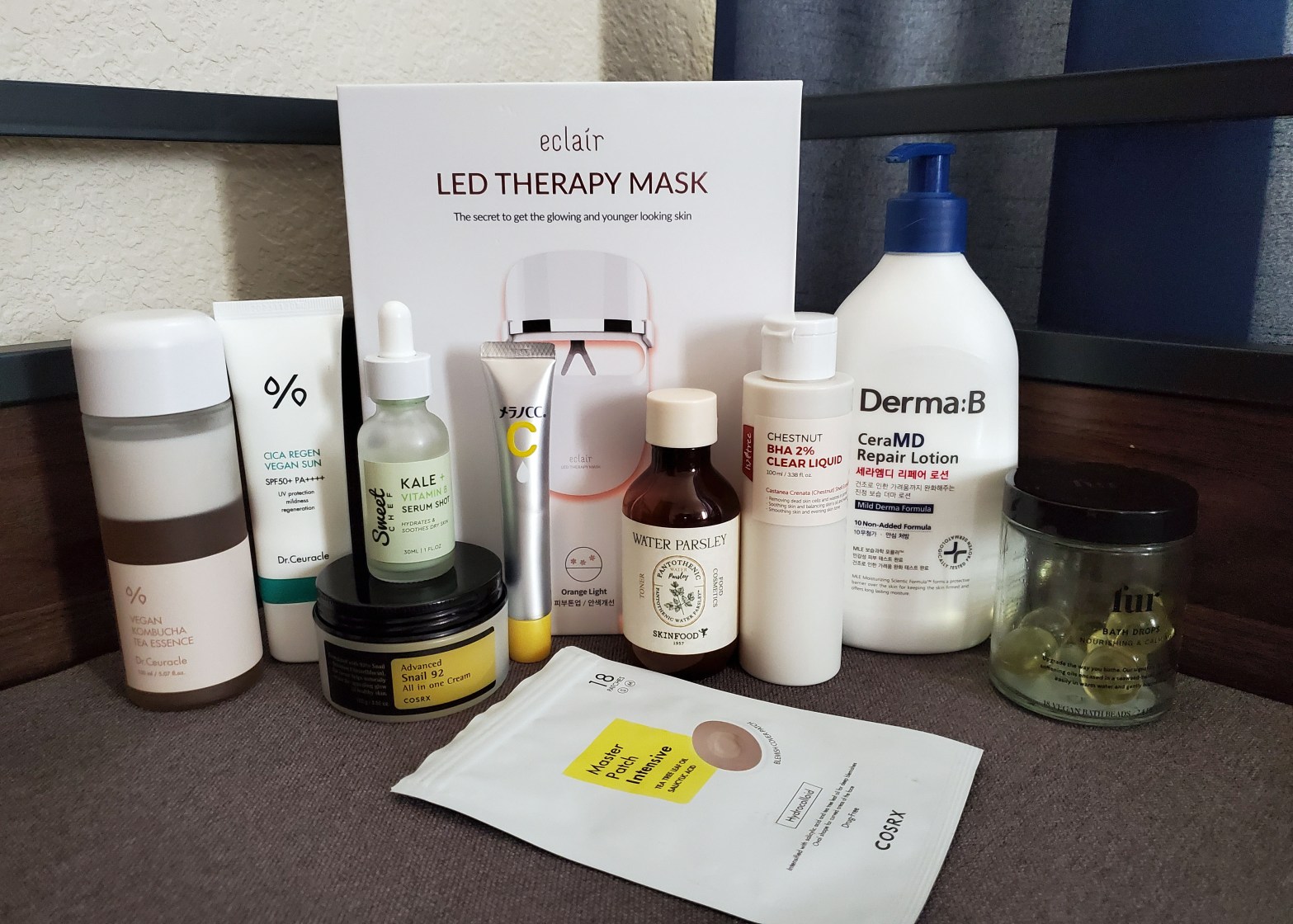
May seemed to be the one month of spring we got this year in Colorado — everything went from dry and windy in April to lush and green, and next month will certainly be back to dry and windy but 30 degrees (Fahrenheit) warmer than in April. May was a weird month for me on a skin front: a small bump on my forehead that I’d had for two year suddenly became enflamed and enormous and get an “epidermoid cyst” diagnosis, only to form three whiteheads and diminish again in three weeks. At the same time, I was also mentally preparing for the routine I’m going to want during an upcoming working roadtrip. All that said, read on for what I started putting on my dry skin last month. Remember that my */10 ratings are only for emptied products, so if you want more info on any of these products, let me know or just wait a few month!

Toners & Essences

🌰 Isntree Chestnut BHA 2% Clear Liquid

If you know much about me, you know that BHA isn’t my go-to — but when I was able to get the Isntree Chestnut BHA 2% Clear Liquid for free thanks to other Isntree purchases through YesStyle, I couldn’t not try it. I finally opened it this month when a forehead bump that I’ve had for two years (that I now know to be an epidermoid cyst) suddenly went rogue, getting large and inflamed. This is thankfully not drying, despite the salicylic acid, willow bark extract and chestnut shell extract, all of which are lipophilic or astringent. I haven’t had a chance to use it for too long, but it will be interesting to see what effect this has on my pores, even if it can’t have one on this forehead bump.
Price: $20 USD / 100 mL

🌿 Skinfood Pantothenic Water Parsley Toner

I received the Skinfood Pantothenic Water Parsley Toner through YesStyle influencer program in exchange for a review, but this is not that review. This is a watery toner that layers up well, but has a bit of a fresh herbal smell due to all the essential oils. In proper k-beauty fashion, ingredient lists for this vary around the internet, but it does seem to have 15% oenanthe javanica extract, or water parsley extract, as well as pantothenic acid, the more biologically available form of B5 than panthenol (though it has that as well). It also has panthenol, centella asiatica extract and chamomile extract for calming. Some of the inci lists I’ve found say it has salicylic acid in it, but my understanding is that due to Korean regulations this couldn’t be at higher than 0.5%.
Price: $15 / 115 mL

🍵 Dr. Ceuracle Vegan Kombucha Tea Essence

At long last, the much-hyped Dr. Ceuracle Vegan Kombucha Tea Essence is in my skincare routine. This is a “bi-phase” essence, basically meaning that the water and oil phases aren’t emulsified — they mix when you shake the container. Because of this creamy essence vibe, many folks compare it to the Laneige Cream Skin Refiner. I personally think it’s a bit more oily, though still without feeling heavy, but I’d be happy to do a Face Off post comparing the two in more depth, if folks are interested. The heroes here are green tea leaf extract (but fermented, so kombucha!) as well as saccharomyces ferment filtrate, green tea water and sunflower seed oil, though it includes a variety of other plant extracts, as well as ceramide NP and Vitamin E.
Price: $38 USD / 150 mL

Serums & Creams

🍊 Rohto Mentholatum Melano CC Vitamin C Essence 2021 Edition

I’ve been hearing about the Rohto Mentholatum Melano CC Vitamin C for ages and although long-time readers will know that I’m obsessed with the Good (Skin) Day C’s the Day serum, I finally had to give it a try due to its availability (C’s the Day has been out of stock for a while) and its roadtrip-readiness. Ascorbic acid is notoriously unstable, but the size (20 mL) and the form factor (in a tube with a unique applicator that dispenses literally drop by drop) of this serum make it a promising travel buddy, and the price doesn’t hurt either. Unfortunately, Rohto Mentholatum does not publish percentages, but thus far this hasn’t irritated my skin at all. Those sensitive to fragrance should know that this has a fairly strong citrusy fragrance to it to mask the characteristic “hot dog water” smell of ascorbic acid, though.
Price: $14 USD / 20 mL

🥬 Sweet Chef Kale + Vitamin B Serum

I guess I didn’t get to the Sweet Chef Kale + Vitamin B Serum soon enough, because it appears to now be discontinued — no longer at Target, and out of stock at Sweet Chef. But let’s hope not, because it’s actually pretty good. This is a hydrating, calming serum, with kale, aloe, turmeric and eggplant extracts for an antioxidant boost. It also has two types of algae extracts in it, which is rare to find at this price point, and are great sources of peptides, amino acids, vitamin c and, of course, antioxidants. This does have a faint fragrance to it from lavender essential oil, but it does not smell like lavender.
Price: $20 USD / 30 mL

🐌 Cosrx Advanced Snail 92 All In One Cream

I’m finally dipping my toe into Cosrx’s snail offerings with the Advanced Snail 92 All In One Cream — I couldn’t resist when it was 50% off at Ulta. My skin has long loved snail secretion filtrate as a hydrator (tough to find good ones in the desert) and as a skin soother and repairer. This is a very simple formula that has snail at (you guessed it) 92%, along with arginine, panthenol and allantoin. It’s very lightweight and has the classic snail stringiness, but works well as an AM moisturizer, or in the PM under another moisturizer as an extra step of hydration.
Price: $26 USD / 100 g

☀️ Dr. Ceuracle Cica Regen Vegan Sun

I picked up the Dr. Ceuracle Cica Regen Vegan Sun last summer in a fit of “huzzah, the good sunscreens are back on the market.” This uses Uvinul T 150, Uvinul A Plus, Mexoryl SX, Parsol SLX and Tinosorb S to hit SPF 50+ PA++++. This does include alcohol to help it dry down better, which is not unusual in nice-wearing sunscreens. It also adds centella asiatica extract, madecassoside, madecassic acid, asiaticoside and asiatic acid to really underscore their cica claim, as well as kiwi extract, lotus flower extract and hibiscus extract for some extra antioxidant benefits. Unfortunately this does have a bit of an unpleasant scent to it due to the lack of a masking fragrance — I want to say it smells a bit like toilet bowl cleaner, though that does, in fairness, fade down quite quickly. Between the smell and the slightly matte finish, I’ve downgraded it to a purse sunscreen rather than a daily sunscreen.
Price: $18 USD / 50 mL

Tools, Single-Use & Body Care

🎭 Eclair LED Therapy Mask

If you, like me, need an excuse to close your eyes and do nothing for 15 minutes, allow me to introduce you to the Eclair LED Therapy Mask. That was legitimately part of my thinking in picking it up. It’s also inexpensive, and has red (for aging), blue (for acne) and even orange (ostensibly for brightening — I still need to research this). This does include eye protection, which you need whether using an LED mask at home or in a salon, but it is pretty clearly an afterthought, as it doesn’t fit well with the way the mask rests on the bridge of the nose. I will admit that this has kept me from using as often as I’d like, and I intend to buy some nicer tanning goggles on Amazon to use instead. So far I’ve used the red and the orange settings, and while they do warm the skin they don’t seem to tingle. I’m hoping to use more consistently this summer and do a more thorough review.
Price: $119 USD

🔴 Cosrx Master Patch Intensive

Though I love the Cosrx Acne Pimple Master Patch, I hadn’t tried the Cosrx Master Patch Intensive until now. It includes salicylic acid and tea tree leaf oil to attempt to explicitly treat the blemish it covers, but that also means it’s not the sort of thing I would usually buy — I tend to prefer plan hydrocolloid patches. That said, I got it for free as part of an order, and when I got the aforementioned big forehead bump I busted these out to camouflage it, keep myself from poking at it and, who knows, maybe even reduce it. These are oval, rather than circular, but they stick fairly well.
Price: $25 USD / 90 patches; shown in an 18 patch size

🧺 Derma:B Cera MD Repair Lotion

Derma:B is my favorite brand for body care at this point, and while I love their lotions I had not yet tried their Cera MD Repair Lotion. The Cera MD line includes the patented Adfence-P from their parent company which helps with the post-bath skin itchies, as well as ceramide NP, panthenol, and allantoin to calm. This also includes meadowseed foam oil, which seems to be one of my skin’s favorites, plus shea butter and grapeseed oil. Derma:B’s lotions are all incredibly lightweight, this one included.
Price: $15 USD / 400 mL

🛁 Fur Bath Drops

It’s no secret that I’m bath-obsessed, and so I’d been eyeing the Fur Bath Drops for a hot minute before they had a 10x points deal at Ulta (AAPI-founded promotion) and a 20% off coupon and I could resist no longer. The guidance is to use 2-3 per bath, which is not as cost effective as it could be — depending upon tub size and bath length, I’d recommend trying just one to see if that work out well. The main oils for moisturization here are grapeeed and jojoba, but it includes a lot of essential oils for the aesthetic (lemon peel, clary, peppermint, camphor … the list goes on). These slowly dissolve in the batah, and though the oil floats a bit on the top of the water, it really does leave the skin feeling moisturized upon emerging.
Price: $38 USD / 18 drops

May Empties Reviews

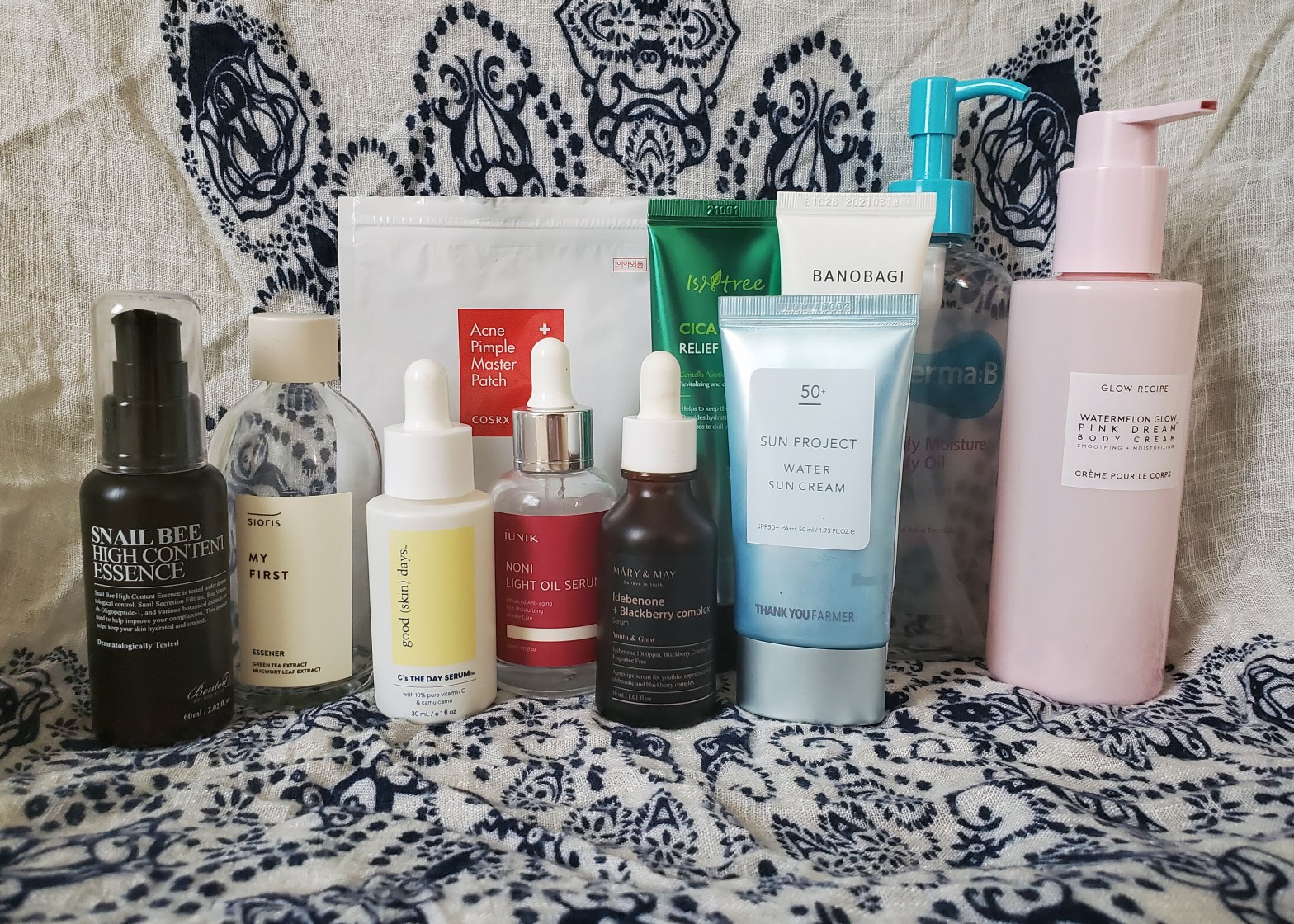
Colorado decided to mostly skip spring and my skincare routine seems to have done the same — May feels more like I’ve been emptying winter products than working my way through seasonal products. May has thankfully been more rainy and less windy, so my skin has been feeling a lot less dehydrated and uncomfortable. Check out my ratings for my empties below, and remember that I always rate based on my own results for my dry skin, so your mileage may vary.

Essences

💧 Sioris My First Essener

Fun fact: if you want to try Sioris, they frequently do giveaways with YesStyle, and I’ve now won two Sioris products through that — the My First Essener was the first. (The other, the cream, didn’t arrive when I used the code so … guess I won’t actually be getting that, alas.) This is considered a combination between an essence and toner. It’s got a slightly thicker texture than a watery toner, which actually made it hard to get out — there were some wild surface tension things going on that made it not dispense by tipping — but still layers up well. This focuses on mugwort and green tea, so if you’re looking for a good antioxidant product and find that mugwort calms your skin, this might be a good pick. For my part, I didn’t find this to help with redness (mugwort just doesn’t do it for me) nor to be particularly hydrating.
Opened: February
Price: $32 USD / 100 mL
Rating: 7/10

🐌 Benton Snail Bee High Content Essence

The Benton Ultimate Snail Bee Serum was my gateway to k-beauty, so I’ve enjoyed using more from the Benton Snail Bee line. I’ve since tried the sheet mask, as well, and I picked up the Benton Snail Bee High Content Essence when I won a giveaway from Nudie Glow US. Despite the name, I would actually argue that this is more like a serum — it’s very gel-like rather than watery, and the sizing alludes to that as well. The hero here is snail mucin, of course, as well as bee venom, which is a natural source of peptides. I struggled a bit with dehydration this spring, but this didn’t feel quite hydrating enough for me, possibly because of the inclusion of willow bark extract. I’d say this would be a great one for those with oily skin trying to heal irritation and PIE from acne.
Opened: March
Price: $20 USD / 60 mL
Rating: 8/10

Serums

🍒 Good Skin Days C’s the Day Serum

I have talked about the Good Skin Days C’s the Day Serum for years, and I feel like I’ve done myself a real bamboozle because it’s been out of stock for multiple months — I sincerely hope that it’s only due to global supply chain issues, and not because Good Skin Days (a Soko Glam brand) is discontinuing it. This is a 10% ascorbic acid serum with niacinamide, licorice root and other plant extracts and it really does bring a glow without being irritating. The only drawback here is because it’s water-based and because of the packaging, it does oxidize within the 4 months it can be open. I kept my open one in a dark bag, and I keep my stashed ones (down to one more ahhhhh) in the cheese drawer in the fridge to slow down the inevitable onslaught of chemistry.
Opened: March
Price: $26 USD / 30 mL
Rating: 10/10

🍓 Mary & May Idebenone + Blackberry Complex Serum

I received the Mary & May Idebenone + Blackberry Complex Serum through the YesStyle in exchange for a review, but this is not that review. Mary & May is a newer k-beauty brand that has a whole antioxidant-focused line based around idebenone, a synthetic antioxidant similar to CoQ10, and blackberry. This serum, in particular, is considered a good vitamin c, antioxidant option for those with sensitive skin who can’t handle ascorbic acid or fragrance. I did see good brightening results from this when I had some fresh PIE, but it did not help to brighten or even my skin tone once that had healed up a bit. That said, I am very curious to try more from this line (the cream) and the brand in general (their sunscreen)
Opened: March
Price: $18 USD / 30 mL
Rating: 9/10

🍍 iUNIK Noni Light Oil Serum

I picked up the iUNIK Noni Light Oil Serum when it was BOGO at YesStyle for Black Friday. I don’t use too much from iUNIK but they got me onto propolis, so I thought maybe they’d get me into noni too — plus I was really curious what a “light oil” serum constituted. This is a milky serum, since it’s 42% noni water paired with emollient oils like macadamia and argan. It’s got a great price point, but I must admit for me there were not clear benefits, or at least not visible benefits I discovered while using it. That said, I think this is a promising antioxidant serum for dry skin, since it does have a variety of plant extracts with those nourishing oils.
Opened: February
Price: $21 USD / 50 mL
Rating: 7/10

Creams

🍃 Isntree Cica Relief Cream

The Isntree Cica Relief Cream was a holy grail from the first use of the first tube I ever got, and this bottle has not diminished that feeling — the only drawback is the price, but if you keep an eye out you can find it for under $20. This has a green tint and a buttery, emollient feel, and I love it as an AM moisturizer to cut down redness and keep my sensitive cheeks comfortable throughout the day. I also love the packaging — the tube makes it easy to use up all the product, and the labeling easily removes for disposal. This is, of course, a cica cream, so it includes centella asiatica extract and asiaticoside, but it’s also chock-full of peptides and other antioxidant extracts, making it a good calming cream that also has additional hydration and anti-aging benefits.
Opened: February
Price: $34 USD / 50 mL
Rating: 10/10

🥛 Banobagi Milk Thistle Repair Sunscreen

The Banobagi Milk Thistle Repair Sunscreen is another YesStyle Black Friday BOGO “for science” pick. This is an SPF 45 PA+++ — I know that some folks insist on nothing less than SPF 50, but considering I gave my goth sister endless teasing for using an SPF 45 in our teens (I used 15 so I could get tan LOL) I figured the protection would be more than enough for sitting at my desk. This a chemical sunscreen with extra skincare benefits from the peptides, niacinamide, panthenol, adenosine, centella, sea buckthorn and, of course, milk thistle extract. This is a very liquidy sunscreen, so I could see acne-prone, oily skin types loving this. I didn’t love it, but that’s more a function of pickiness than anything else. I ended up keeping it on my desk to use it on my face, neck, chest, arms and hands.
Opened: March
Price: $20 USD / 50 mL
Rating: 7/10

👩‍🌾 Thank You Farmer Sun Project Water Sun Cream

It’s rare to find a Korean sunscreen available from US retailers, but if you want a representative experience that you can get from Soko Glam or Costco, Thank You Farmer Sun Project Water Sun Cream is for you. This is SPF 50 PA+++ — usually an SPF 50 will have PA++++, so I’m going to blame that on the US UVA filters. This feels moisturizing without adding any heaviness — it even passed the husband test, and he hates feeling like he has products on his skin. This does leave a dewy finish, but due to the moisturizing feeling I think that more oily skin types could skip the AM moisturizer and thus cut down on the dew factor. This does have an apricot masking fragrance to it, but I actually love it. This tube was from Soko Glam but I purchased two more through a good deal at Costco and already gave one away because nothing says love like skincare.
Opened: February
Price: $23 USD / 50 mL; get two tubes for $32 at Costco
Rating: 10/10

Body + Other

🛢Derma:B Daily Moisture Body Oil

If you’ve been here for a minute you know I love Derma:B and that I love body oil — so it’s no wonder I went through the Derma:B Daily Moisture Body Oil in a month. This is the second oil I’ve tried from Derma:B — the first one being the Intensive Barrier Multi Oil — and I must admit I prefer the other. Both are predominantly sunflower and grapeseed oil, and in proper Derma:B fashion include the MEA synthetic ceramide, but while the pump in this version makes it a bit easier to use, I liked the added ceramides, panthenol and peptides in the other version, all without being that much more per mL. This does have fragrance, though it’s more for masking than for imbuing a scent.
Opened: April
Price: $14 USD / 200 mL
Rating: 8/10

🍉 Glow Recipe Watermelon Glow Pink Dream Body Cream

I wanted to love the Glow Recipe Watermelon Glow Pink Dream Body Cream — wouldn’t have gotten it for myself for Christmas if I hadn’t — and I am astonishingly disappointed. The smell is fine, if you like fake candy watermelon smells (it does smell notably different than their toner), and the texture is nice and thick and buttery. Unfortunately that texture is also its downfall: this comes with a beautiful pump that barely works. I could have finished this months ago but honestly it was just too much of a pain. It was even difficult to repot, since those watermelon, mango and bacuri butters and oils just Do Not Budge. This has AHA in it, but I never really used it consistently enough to see any exfoliation benefits.
Opened: January
Price: $28 USD / 240 mL
Rating: 3/10

🔴 Cosrx Acne Pimple Master Patches

I don’t always get pimples during my period, but when I do: Cosrx Acne Pimple Master Patches. I can’t not pick, when I do, but these let me touch my blemished skin all I want without picking and leaving myself with a red spot. These have three sizes, which is pretty convenient — I usually use the small and medium, but as I’ve been dealing with an epidermoid cyst on my forehead I’ve been loving the big sizes to camouflage it from myself. These aren’t medicated, and stick nicely under or over skincare.
Opened: February
Price: $4 USD / 24 patches
Rating: 10/10

Skincare Experience: Getting a HydraFacial

It’s no secret that I love me some self-care: I run a skincare blog, I run a skincare group, I bathe so often I occasionally wreck my skin barrier, and I recently invested in a monthly massage package at a local day spa. In my effort to be a high-functioning adult human less and a puddle of goo more, this past week I added a HydraFacial to my day.

What is a HydraFacial?

HydraFacial is a patented technology that uses a pen-like applicator and a series of exfoliating and hydrating steps to, well, exfoliate and hydrate the skin. The basic HydraFacial consists of three steps: “cleanse + peel”, “extract + hydrate” and “fuse + protect”, though there are boosters available for specific skin concerns. All steps are completed with the same applicator, though the serum being applied varies between steps.

“Cleanse + Peel” foregoes the face wash by heading straight to a glycolic and salicylic acid mix that commences the dissolving of any debris on your face, as well as prepping the top dead layers of skin, as well as any debris in your pores, to be removed.

“Extract + Hydrate” is the step that pulls that loosened gunk out. The pen-like applicator vacuums it up in a vortex-like fashion, while keeping the skin hydrated.

“Fuse + Protect” is the final step of the HydraFacial, exclusive of any booster treatments. It is primarily a low-molecular-weight hyaluronic acid serum, though it also includes peptides and antioxidants. This is the step that REALLY hydrates, despite the name.

Skincare the Week Before the HydraFacial

Given the fact that the HydraFacial is basically a strong exfoliating treatment, I would normally recommend not exfoliating the week before, or really reducing the amount of exfoliation you do.

This … is not what I did. In fact, I did the opposite. Sunday night a spot that I’ve had for a long time became puffy and inflamed. In hopes that maybe I could get it to do SOMETHING in time for my Friday appointment, whether it would go away or actually become extractable, I blasted my face and the spot with salicylic acid (the Isntree Chestnut BHA 2% Clear Liquid — more to come on that in my May Openeds). Unfortunately it just got bigger as the week progressed, though thankfully less tender. Current theory on that is that it’s an inflamed cyst, so more there as the situation evolves.

Otherwise, I kept my routine the same. The only change I made was to not use retinol or that BHA the night before my appointment, just to play it a bit safer.

If you have any questions about what not to use before your HydraFacial, you should definitely consult with the spa where you’re having the treatment performed — waxing, strong exfoliants and strong retinoids are typically off the table for 48-72 hours beforehand.

Experience at the Spa

I love day spas because they turn a self-care moment into more of a self-care day, and this certainly qualified. We (my husband always comes too) had mimosas and deep tissue massages before our facials (he went for a standard facial rather than a HydraFacial), so I was pretty chill going in to the treatment. Heading in, the general vibe is very standard facial, but with the notable difference of the HydraFacial cart.

Most HydraFacials focus on the treatment itself rather than doing extractions and such, simply because the tool itself takes care of most of that, but your esthetician will look at your skin just to make sure there’s nothing (like a cyst) to be wary of. Once the examination of my skin was complete, it was time to start the first round of the HydraFacial.

No step of the HydraFacial feels any different from any of the others, frankly, except that on the first pass of the pen you’re a bit less damp — my esthetician actually gave me a tissue to help with any product that might drift into my ears. Despite the pen being pore vacuum-like and dragged across the skin, there’s no sensation of pulling, except for at the very beginning before the skin has any slip from the various products. In fact, it almost feels like there’s a lot of fuss over nothing, if you’re the sort of person who thinks that “if it hurts it must be working.”

The three passes of the HydraFacial pen — the first to cleanse and exfoliate, the second to extract, the third to rehydrate — go by fairly quickly.This is a good facial to talk through, if you’re a huge nerd like I am, since there’s also not the focus on massage and relaxation. Each round takes around 10 minutes. It’s a face-only procedure, which makes sense since the pores and glands on your neck and chest don’t function quite the same, though those hoping to tame cystic acne along the jaw line might find this a bit disappointing.

After the HydraFacial itself, my esthetician applied a light moisturizer (which hopefully had SPF? I should have asked. Luckily the UV index was not as high as it usually is in May in Colorado) and lip balm, and we were done with the treatment itself.

She did ask if I wanted to see the gunk, which of course I did: all of the liquid and debris pulled from your face gets stashed in a little container, which she illuminated with her phone light. I’m not prone to too many whiteheads or blackheads, but there were what looked like quite a few tiny grains of sand in there — all gently extracted from my face.

HydraFacial Aftercare

In typical Lisa fashion, the use of hyaluronic acid did start to make my cheeks feel a bit uncomfortable by the time we got home, so I slathered on some more moisturizer and popped on some Vaseline. If we had not been planning to stay in the rest of the day and my cheeks hadn’t been feeling a bit grumpy I would probably have opted for a sunscreen instead, and might recommend bringing one with you to apply when you’re done. After all, the HydraFacial is a fairly intense, albeit gentle, exfoliation.

I did do a PM routine that evening but kept it simple with just hydration and moisturization. The next morning, I did my standard AM routine — paying special attention to antioxidants and sunscreen. By the evening, I figured retinol was once again a “go” and buffered that. I anticipate that I’ll exfoliate again Monday or Tuesday, so three to four days after the HydraFacial. Those with more sensitive skin might call this their only exfoliation for a while, and would be just fine in doing so.

My Final Thoughts

I’m very glad I got a HydraFacial just to see what the hype was about. I can see why this, rather than a classic facial, would be more recommended before big events. Manual extractions can be more uncomfortable, leaving my skin a bit blotchy after, whereas after the HydraFacial I looked to be properly glowy. I think this is also a good option for those with sensitive skin who need a bit of an exfoliation “tune up” and can’t handle leave-on exfoliants or the exfoliating masks that have to stay on your skin from 2-20 minutes. If microdermabrasion was too much for your skin, “hydra-dermabrasion” may be just right.

Would I get it again? Probably. I don’t feel the need to get facials, Hydra- or otherwise, too often, since my skincare is pretty tuned and I don’t feel like I need many extractions. (Beyond this dang cyst. Please someone get it off my forehead, stat.) The price is also high enough, due to the device, that it’s not something that fits nicely into my budget every quarter or so. (For context, the HydraFacial was a bit more than double the cost of a normal facial.) That said, I would do it before a big event in a heartbeat, especially if I didn’t feel like my skin was living its best life.

Skincare How To: Starting a Retinoid

If you’ve been getting at all into skincare, you might be wondering about starting some sort of retinoid, be it retinol, retinal, adapalene or tretinoin. I will admit I was wary of using retinol for a long time, but now I use it nearly daily! Assuming you already know what’s what, jump right into the “How to Get Started” section. Otherwise, you might want to start with the “Frequently Asked Retinoid Questions”.

Retinoids are a go-to for many for acne (adapalene is recommended at age as young as 12 for this purpose) but become a more common occurrence in routines as the signs of aging start to rear their heads. It’s also a great way to fight hyperpigmentation concerns like post-inflammatory hyperpigmentation and erythema, as well as melasma. Vitamin A, from which retinoids derive, is critical to cell growth, and topically applied has been shown to increase skin cell turnover.

How to Get Started

It’s not unusual to have some trepidation when starting your first retinoid, and that’s probably a good thing. Being cautious as you start will help you see better results than if you just YOLO your way through introducing these products. These steps are good to keep in mind any time you’re introducing a new retinoid, even if you’re an experienced user.

Step 1️⃣: Establish a baseline

Retinoids change your skin over the long-term, so it’s important to know how your skin is doing going into it. Consider taking a “before” picture, so you can see your progress over time. Even more importantly, make sure that your skincare routine is stable. It can be tempting to pick up ALL THE ACTIVES and start everything all at once, but you really want to be able to pinpoint how your skin is reacting to the retinol. Get your skincare routine nailed down so you know what your skin’s baseline is before starting a retinoid.

Step 2️⃣: Pick a product

Skincare enthusiasts can tend towards seeking higher and higher percentages (think niacinamide serums at 10 and 20 percent, when the studied values are between 2 and 5), and that inclination might be there with retinol. Don’t give in to it. You’ll get more benefits from something you can use more regularly with less irritation than something that will live in your drawer because it stings too much. I recommend looking for a low percentage retinol, particularly an encapsulated one. The encapsulation basically makes it “slow release”, which minimizes irritation. My usual recommendations for starter retinols are the ones from Versed and Stratia for this reason, and I did a comparison among them and Indeed Labs last summer in Face Off of the Starter Retinols: Versed vs Stratia vs Indeed Labs. I’m currently using the retinol from Good Molecules, pictured, which is a slightly higher percentage but still quite gentle. If you’re starting out with an adapalene or tretinoin because you’ve gotten a prescription, know that the next three steps are going to be pretty important.

Step 3️⃣: Ease in

Once you’ve picked your product and established your baseline, you can start using your retinoid. Directions on the package can be misleading, as your skin will go through a retinization process before you may be able to use as directed. I suggest a week by week approach:

  • Week 1: Use once
  • Week 2: Use twice (1 week after initial use, then halfway through the next week)
  • Week 3: Use thrice

Repeat specific weeks for as long as needed based on how your skin reacts. After 2-6 weeks, your skin should be fairly through the retinization process, and you can use as often as the packaging dictates, or as often as your skin and routine can handle.

Step 4️⃣: Buffer or sandwich

It is a truth universally acknowledged that products applied first, especially if on damp skin, will penetrate the most. In the case of a retinoid, this may not be desirable. For this reason, many folks will buffer or sandwich their retinoid. Buffering is the process of applying moisturizer (or maybe just many moisturizing serums and emulsions) before applying the retinoid. It is also sometimes used to refer to mixing your retinoid with your moisturizer. I personally prefer not to mix, lest I wind up with an uneven application, but depending upon your routine that may work for you. Sandwiching can also work well, which is really just applying another layer of moisturizer (or oil or sleeping mask) over top of the retinoid. You may not want to slug with retinoid, however, since locking the retinoid in may not be desirable. I highly recommend doing it on “off” nights, though. One technique I use is to do my routine earlier in the evening, and then apply my retinoid and a sleeping pack relatively close to bed.

Step 5️⃣: Watch out for dryness and purging

There’s a good chance that your skin will get drier when starting a retinoid — this is one of the reasons some folks use it as a spot treatment for pimples. This isn’t necessarily a problem, but it can increase irritation, especially if your skin is dry in the first place. You may want to change out what you’re using before your retinoid, or take a closer look at Step 4. You may also start to experience purging, which is basically an increase in acne in spots that are already prone towards acne and clogged pores. Purging is NOT breaking out in brand-new areas — if that’s occurring, it might be a sign that your skin barrier is impaired or that the product is not for you. Both the dryness and the purging are indicative of your increased cell turnover, so stick with it, but I recommend slowing down if you experience either of these symptoms just so you’re not miserable and frustrated.

Frequently Asked Retinoid Questions

What is a retinoid?

“Retinoid” is a general term for derivatives of Vitamin A. For the purposes of this post, I’m specifically using the term of “retinoid” to refer to topical products, whether OTC or by prescription, that include retinol, retinal, or retinoic acid, though these are by no means all of the Vitamin A derivatives. Vitamin A is an antioxidant, and critical for cell growth. Many skincare users choose to introduce a retinoid in order to fight acne or signs of aging.

What is the difference between retinol, retinal, adapalene and tretinoin?

It is typically helpful to think of retinoids in terms of how far removed they are from being all-trans retinoic acid (atRA), which is used in cell growth. The more transformations it goes through, the gentler and weaker it is. All that to say, in layperson terms: retinol converts to retinal converts to retinoic acid (aka tretinoin). For this reason, retinol tends to be the weakest of the bunch, unless in particularly high percentages. Retinal is less common, though growing in popularity, as retinaldehyde is that much closer to being retinoic acid, and more bioavailable. Tretinoin, or retinoic acid itself, is only available by prescription in many countries for this reason, but is considered the gold standard for anti-aging. Adapalene, which was once also prescription-only, is not entirely on this conventional retinoid ladder because it is formulated to bond with different receptors, and in so doing gets many of the acne-fighting benefits without the drawbacks.

What is retinization? Should I expect to purge?

Retinization is the process of the skin getting accustomed to the retinoid (tautological, I know). It typically lasts 2 to 6 weeks, in keeping with the skin’s natural turnover cycle, and is characterized by dryness and an increase in inflammation and acne. For some folks, especially as you increase your frequency of use, you may expect this retinization period to last up to three months. If you’re acne-prone, you should definitely expect to purge — as your cell turnover increases, you can think of the retinol as pushing out all the current gunk in your skin. Even if you’re not acne prone, but, say, inclined to a few spots every month, it’s quite likely that these spots will arrive all at once.

When should I apply my retinoid? What can I use it with?

In the PM, and typically not with any other active, like exfoliating acids. Retinoids are not always photostable, so putting them on at night lets your skin really put them to work — plus that’s the routine when you’re probably focusing on skin barrier health anyway, so you’ll probably also face less irritation. This concern about irritation is also why it’s suggested to not use a retinoid in a routine with exfoliating acids — no reason to double down on the irritation if you don’t have to.

Can I put my retinoid on my neck and chest?

Ideally yes, but your neck and chest might not get along well with it. The neck and chest have fewer sebaceous glands, and can get more irritated from topical retinoids. If this is the case for you, you may look at getting a separate, gentler retinoid for your neck and chest, or being sure to buffer in those areas.

How long do I need to use my retinoid to see results?

The length of time it will take you to see results really varies depending on what results you’re hoping to see and how strong of a product you’re using. For my dermatitis, I noticed improvements after a month. For acne, you have to get through the purging process first. For aging and pigmentation concerns, you’re probably facing at least three months.

What is bakuchiol? What are phyto-retinols?

Bakuchiol is a compound derived from the babchi plant, and at a 1% level has been shown to potentially increase collagen synthesis while helping with skin tone and texture. For this reason, it’s considered to be a phytoretinol, as the effects are similar though less intense. Rosehip seed oil is also considered a phytoretinol due to its naturally high levels of Vitamin A.

Can I use retinoids while trying to conceive, pregnant or breastfeeding?

The research varies, and frequently includes non-topical retinoids, which you can’t really extrapolate to topical retinoids. I always recommend that you talk to your doctor if you’re not sure what to use. Many folks concerned about this opt to use a phyto-retinol rather than a retinoid.

April Openeds Reviews

April was rough in Colorado — the whole time, it was so windy I barely emerged from my hermit cave. But I’m starting to look forward to summer, and time spent outside. My new skincare choices reflect this: these are mostly more transitional textures — not too heavy, not too light, easy to include or not include in a routine based on how my skin and the weather is doing — and I’m targeting emptying them all before we get into the height of summer, with its sun exposure and grime from outdoors.

Wash-Off Products

🐘 Drunk Elephant E-Rase Milki Micellar Water

I picked up the mini version of the Drunk Elephant E-Rase Milki Micellar Water in a fit of “I want to wear makeup more often but I really suck at doing eyeliner so I need a no-rinse makeup removal option.” Then it turned out I’m too lazy to wear makeup very often, so I decided to just open it and use it as a first cleanse, as micellar waters usually are, or as a lazy cleanse in the morning when I feel I need something. Most micellar waters need to be rinsed, but due to the surfactants this uses, Drunk Elephant says that it does not. This formula’s claim to fame is the watermelon seed oil as well as three ceramides and a ceramide precursor. My main issue with this at the moment is that it smells quite a bit like Play Do upon application, unfortunately.
Price: $28 USD / 240 mL; shown in the $14 USD / 100 mL mini size

🍵 I Dew Care Matcha Mood Soothing Green Tea Wash-Off Mask

I initially tried the I Dew Care Matcha Mood Soothing Green Tea Wash-Off Mask in a mini size when I took it to Belize in summer, and liked it so well I decided to rebuy during a Black Friday sale. I’m a big fan of a soothing mask after an exfoliating mask, or when heading into the shower. This is a creamy, moisturizing mask that uses green tea extract, CBD oil, aloe extract, centella asiatica extract, heartleaf extract and chia seed extract to soothe. It’s also, satisfyingly, very green, though that’s partially due to dyes.
Price: $25 USD / 100g

Toners & Serums

💦 RNW Der. Special Ceramide Mist

I love the RNW Der. Concentrate Ceramide Plus Serum, so I was excited to try the RNW Der. Special Ceramide Mist. Like that serum, this includes 5 types of ceramides, a ceramide precursor and cholesterol. It also includes panthenol, a peptide, and a bunch of prebiotics. The mister on this makes it take quite a few sprays, so it doesn’t seem quite as hydrating as I would like for a mid-routine spritz, but I’ve started using it with more alacrity — life’s too short to tiptoe around your products — and I’m enjoying it much more. It’s also pretty aesthetically fun: this has a biphase-like effect due to the combination of water- and oil-based ingredients with minimal solvents, so it swirls in the light.
Price: $27 USD / 100 mL

💧 Isntree Hyaluronic Acid Water Essence

I received the Isntree Hyaluronic Acid Water Essence in a giveaway last summer, but delayed opening it due to my general avoidance of hyaluronic acid, particularly products that focus on it as an ingredient. Hyaluronic acid is a humectant that naturally occurs in the body, and because of that and its price point has become incredibly popular. Unfortunately, it tends not to work for me between my skin’s dehydration and my environment’s dehydration, and that seems to include this serum. After using this the first morning, my cheeks felt tight and irritated by the afternoon. I am able to use it in the evening, but only if I slug with Vaseline, and even then it seems to irritate after a few consecutive uses so I’ve given up. For the moment this is living by my tub, and I use it on my legs and body after the bath.
Price: $31 USD / 50 mL, though frequently cheaper on some retailers

💜 Pacifica Vegan Ceramide Face Serum

It is a truth universally acknowledged that if a brand releases a ceramide serum, I will eventually try it — and so here we are with Pacifica’s Vegan Ceramide Face Serum. This is an emulsion texture, so it goes down pretty fast — it requires about three pumps to cover face, neck and chest. This includes ceramides NP, AP and EOP, as well as ceramide precursor phytosphingosine. As you might remember from my Face Off of the Ceramide+Cholesterol+Fatty Acid Serums: Glow Recipe vs RNW vs Stratia post, it importantly also includes cholesterol and a variety of fatty acids, along with a few plant extracts. I could see this working well for someone who needs a more accessible version of Stratia Liquid Gold, honestly.
Price: $16 USD / 29 mL

🐝 Toun28 Propolis + Vitamin C, B3, B5, B6 Serum

I first learned about Toun28 due to their eco-friendly approach to packaging, so I picked up the Propolis + Vitamin C, B3, B5, B6 Serum because I can’t not try new propolis serums — it’s a similar compulsion to my relationship to ceramide serums. This has 88% propolis extract, 2% ascorbyl glucoside (a vitamin c derivative), 1% niacinamide (vitamin b3), 1% panthenol (vitamin b5) and .05% pyridoxine hydrochloride (vitamin b6). This includes a variety of other plant extract, in addition, to add up to an incredibly lightweight, beautifully fragrant serum that feels really special to use. I’m looking forward to trying some of their other products.
Price: $35 USD / 30 mL

Creams

💚 Good Molecules Gentle Retinol Cream

The Good Molecules Gentle Retinol Cream is a beginner retinol at .1% and bakuchiol to boost the effects. While I’m not new to retinol, I appreciate a gentle one so I don’t have to worry about using it on a schedule — not only do I wind up being able to use them every day, I can layer them with exfoliating acids. This is a light cream formula, so on the days that I’m using it (this recommends 3 times / week, but I’m doing my classic “ease into it” approach that I’ll detail next week) I do still use a moisturizer over top. Beyond the retinol and bakuchiol, worthwhile callouts are the sunflower seed oil, willow bark extract and green tea extract. And, of course, the price.
Price: $8 USD / 30 mL

🇰🇷 Beauty of Joseon Dynasty Cream

Beauty of Joseon is such a great brand, and I’m so excited to finally be using their reformulated Dynasty Cream, since it’s been recommended to me so many times. This has a really fun texture to it and even physically looks hydrating. I’m really enjoying it as a PM moisturizer so far, and think that this could make a good day cream as well. The INCI of the new formulation is a grab bag of yumminess: rice bran water, ginseng root water, niacinamide, squalane, honey extract, a ceramide, and a variety of plant extracts. Importantly, the reformulation is also fragrance free.
Price: $25 USD / 50 mL

Other

🍯 Farmacy Honey Butter Lip

I’m not usually one to drop $10 on a chapstick, but I received the Farmacy Honey Butter Lip as part of a promotion they did in autumn and I must admit, I don’t hate it.That said, you will note that it is not pictured because I seem to have ALREADY LOST IT. Will I find it again such that y’all will see it in a future empties? Unlikely, but we can hope. Some lip balms can melt off my lips and give me bumps and blackheads, but so far so good with this one even though it includes all three of the potential culprits I had been concerned about: castor oil, olive oil and coconut oil. This also includes cacao and cacao blanco butters, and beeswax and candelilla waxes to give it emollience and occlusion. In keeping with the rest of the honey line, this also includes honey, propolis and royal jelly extracts.
Price: $10 USD / 3.4 g

☀️ Derma:B – Everyday Sun Block SPF50+ PA++++

It’s no secret that I love Derma:B for body products, so I had to try their Everyday Sun Block SPF50+ PA++++ for body sunscreen. This quite a bit heavier than other Korean sunscreens I’ve tried, but still more comfortable than those from the US. This includes the synthetic ceramide used in seemingly all Derma:B formulations, in addition to prickly pear extract, cucumber extract, aloe vera extract and chamomile extract. This is quite fragranced, but not unpleasantly so. The sunscreen filters used in this are homosalate, octisalate, avobenzone and ensulizole.
Price: $15 USD / 200 mL

🛢 Derma:B Daily Moisture Body Oil

I’ve been wanting to try the Derma:B Daily Moisture Body Oil for a while — after all, Derma:B plus body oil is basically my body skincare love language — but it can be perniciously hard to get ahold of. This is a blend of multiple lovely oils: sunflower seed, grape seed, canola, camellia seed, argan and sweet almond. This again also includes the synthesized ceramide MEA. It doesn’t include any surfactants, so I apply it to my legs and lower body rather than putting it directly into the water.
Price: $14 USD / 200 mL

April Empties Reviews

This month feels like a (comparatively) light month for empties for me. Between being slammed at work and having a new puppy, I didn’t always take the time for myself and my full-fledged skincare routine. It’s always interesting to see the rate at which I go through products, though — it feel like I empty wash-off masks within two months and serums every 2-3 months. Next month’s empties will feature a lot of toners, no doubt, since they seem to be offset on my skincare cycle.

Wash-Off Products

🌻 Then I Met You Living Cleansing Balm

I’ve dug the aesthetic of Then I Met You for so long, and the Living Cleansing Balm looks so nice and so many folks love it that I really wanted to love it. But my first impressions were pretty much right on: this does not melt down easily, and so it takes a lot to get enough coverage to really massage in and emulsify. The ingredients in it are lovely — sea buckthorn oil, olive oil, grape seed oil, etc — but there are better cleansing balms out there that are way more accessible. For what it’s worth, I also wasn’t impressed by their Giving Essence, but I do want to give the brand another try before writing it off entirely.
Opened: March
Rating: 7/10
Price: $38 USD / 90 g; shown in the $6 USD / 10 g travel size

🍵 TONYMOLY I’m Green Tea Hydro-Burst Morning Mask

TONYMOLY products are always cute, and the price point on the I’m Green Tea Hydro-Burst Morning Mask made it a must-try for my self-care loving self. This is a green gel mask, which scoops out easily to spread all over face, neck and chest. I used it frequently after using exfoliating masks, when I must admit it was not very nourishing or restorative. But then I tried it in the morning before showering and, well, that’s probably why they called it a morning mask. It was cooling upon application, and kept my face shielded from the hot water of the shower. While I don’t think this gave me any skincare results per se, I did enjoy it.
Opened: February
Rating: 9/10
Price: $15 USD / 100 mL

Toners and Serums

🥛 SANA Soy Milk Wrinkle Care Lotion N

The SANA Soy Milk Wrinkle Care Lotion N is a lotion that’s actually a toner — it’s a Japanese brand, where that naming convention is common. This includes retinol, retinyl palmitate, as well a a bunch of soy ingredients: fermented soybean milk, soybean seed extract, soy protein, soy isoflavone. Isoflavones, the main antioxidant in soybean, has really interesting implications for anti-aging in terms of increasing skin thickness, so pairing it with retinol just makes sense. SANA doesn’t disclose the retinol percentage in this, but if you’re retinol-wary it might not be a bad place to start. By the time I finished using this, I was using three layers of this every night as part of my toning step. I will say I’m not sure how effective it was, to that end, but wow was it a cost-effective option.
Opened: October
Rating: 8/10
Price: $22 USD / 200 mL

💚 Purito Centella Unscented Serum

The Purito Centella Unscented Serum is without a doubt one of the most popular products from Purito, and possibly one of the most possible k-beauty products in the western market. Most folks use this as a peptide serum, and western brands tend to price gauge for peptides. This has 49% centella asiatica extract, as well as niacinamide, ceramides and, of course, four peptides. Unfortunately I found this to be pretty fussy to use. Going on by itself, it felt a drying and tacky, even with a mist applied after to attempt to rehydrate it. I tried cocktailing it with my essence (the Benton Snail Bee High Content Essence), but then I couldn’t immediately use my ascorbic acid without worrying about denaturing the peptides. Suffice it to say, I wanted to love it but I just don’t.
Opened: January
Rating: 6/10
Price: $20 USD / 60 mL

💛 Epicuren Noni Skin Elixir

I picked up the Epicuren Noni Skin Elixir from The Spa at The Brown Palace when we did a staycation in Denver for my 34th birthday, and used it all through the window as a serum for my Nuface, as well as the occasional hydrating serum. The main base of this is aloe vera, but of course it also includes noni, an increasingly common fruit ingredient in skincare due to its antioxidant content. It was fine — nothing to write home about. Really the biggest drawback to this serum was its smell, as it just always smelled like Play-Doh.
Opened: January
Rating: 6/10
Price: $25 USD / 60 mL

Creams and Lotions

💧 Neutrogena Hydro Boost Water Gel

I picked up this sample of the Neutrogena Hydro Boost Water Gel ages ago a while ago for my husband. I never got him into it, and I never really got myself into it. In fairness to this moisturizer, I probably should have gotten the much more popular Neutrogena Hydro Boost Gel-Cream with Hyaluronic Acid for Extra-Dry Skin (the fragrance-free one), but I just never made this work for me, and I disliked the smell to boot.
Opened: January
Rating: 2/10
Price: $11 USD / 14 g

🩹 First Aid Beauty Ultra Repair Cream

The First Aid Beauty Ultra Repair Cream is super popular, and I can see why. Given the branding, I expected this to be quite heavy, and it does take a bit of blending to avoid streakiness. That said, it’s a nourishing but medium-weight cream, with some emollience and hydration but no inclusive. Key callouts here are colloidal oatmeal, shea butter, ceramide NP as well as green tea and licorice extracts.
Opened: March
Rating: 8/10
Price: $38 USD / 6 oz; shown in a 1 oz travel size

Zeroid Intensive Cream

I picked up the sample of the Zeroid Intensive Cream when hitting up a good Atopalm sale, and, in short, I’m mad at how much I like it. I really like this.This is a really nice, plush cream that looks simple on the surface but is actually so nice. Atopalm is the same brand that does Derma B, dermArtology and Real Barrier, and their big claim to fame is their MLE (multi-lamellar emulsion) technology which functionally reinforces the skin barrier. This also includes phytosterols and a synthetic ceramde, which between the two can help prevent the breakdown of collagen in the skin. I used it as my PM moisturizer once I ran out of the FAB and I will definitely repurchase someday. Unfortunately, Zeroid’s a bit hard to find, so that will probably be through Atopalm’s actual website.
Opened: this month
Rating: 10/10
Price: $32 USD / 80 mL; shown in a sample size

👄 Aquaphor Lip Repair

For all that I love fancy, esoteric skincare, you really can’t go wrong with Aquaphor Lip Repair. When my lips feel wrecked from the weather, from red wine, or whatever other abuse I’ve heaped upon them, this gets them back to feeling not-painful in record time. I keep a tube stashed on my bedside table so that way I’m never tempted to enter the awful cycle of licking my lips to make them less dry, only to have that dry them out.
Opened: who knows, it’s a win to have emptied it without losing it
Rating: 10/10
Price: $4 USD / 10 mL

Other

👀 Fourth Ray Beauty Chill Sesh Hydrating Eye Masks

I’ve become an eye patch convert, and Fourth Ray Beauty Chill Sesh Hydrating Eye Masks are some of the best I’ve tried. I never try to use them during my routine — I don’t want the rest of my skin to dry out — but I love them for a mid-day pick up. I find that eye patches can really help reduce eye strain. These are nice because they’re the only ones I’ve found so far that don’t pill up after removal. No one want to be mid-video call picking balled-up skincare off. These have a very delicate material, however, so it can be easy to rip them if you YOLO it and pick them up with your fingers rather than the provided spatula.
Opened: November
Rating: 9/10
Price: $15 USD / 30 pairs

💈Some By Mi Cica Peptide Hair Loss Treatment

I do not have a lot of hair, so while maintaining it is important to me, it took me a while to go through the Some By Mi Cica Peptide Hair Loss Treatment. I was experiencing a lot of hair fall last year — I would literally feel it falling from my head onto my shoulders in the bath, for example — and there is some evidence that peptides do help keep hair from falling out. At the price point, I figured there was no reason to not test it out. In the last year, my hair really has gotten thicker, to the point that now I’m rocking a long undercut without worrying about my recessive balding pattern. I’m moving onto try other hair loss products now, but I can see myself coming back to this.
Opened: March 2021
Rating: 10/10
Price: $8 USD / 50 mL

🛁 Neutrogena Body Oil

If you’ve been here for a while you know I love the Neutrogena Body Oil. I take baths long enough to really wreck my skin barrier, and having an oil in the bath is an immeasurable help. This has some surfactants in it, so doesn’t just float on top of the bath, like some body oils. (Incidentally, this is what makes it a great cleanser for dry body skin, or even a first cleanse for the budget conscious.) I do wish that this big size were easier to find and available in the unfragranced version, as I much prefer it that way, but at the rate I go through bath oil I’ll take what I can get.
Opened: December
Rating: 10/10
Price: $30 USD / 946 mL

Skincare How To: Create a Serum Collection

I’ve been crushing on my serum line-up lately. A nice “serum stable” is eminently shelfie-worthy and so important as you learn to listen to your skin, but building one out is where so many skincare newbies go wrong and where so many skincare fanatics can go overboard. So let’s discuss.

A few notes before we get into it:

  • While I use exfoliating acids, retinol and ascorbic acid, I’ve excluded those treatment serums from this post since routines and rotations with those tend to be very specific to what your skin can tolerate.
  • All the various serums and categories of serums I’m about to discuss can theoretically be layered with any actives, though as with all skincare, your mileage may vary.
  • Not all skin can take a lot of layers, and not all wallets can take a lot of serums. At the end of the day, a good skincare routine is one that leaves you, your skin and your financial situation healthy and happy.

❔What is a Serum? And How do Ampoules and Essences Fit In?

The typical definition of a serum is something like “a step between cleansing and moisturizing that focuses on delivering high concentrations of active ingredients to the skin” but I always feel like that lacks nuance, and can leave you thinking that only, say, lactic acid serums qualify as serums. Rather, serums typically focus on one skin concern, or delivering one set or category of ingredients: think the ever-popular The Ordinary Niacinamide 10% + Zinc 1% Oil Control Serum, or many folks’ first k-beauty serum Purito Centella Unscented Serum. Ampoules like the Cosrx Propolis Light Ampoule also fall into this category, and many folks use essences like the Benton Snail Bee High Content Essence as serums as well.

My “is this a serum” rule-of thumb? Thicker than a toner, lighter than most moisturizers, basically always in a dropper or pump bottle, usually found in 30 mL sizing though occasionally in 50 mL and, once in a great while, in 100 mL sizes. Can be watery, jelly or lightly creamy in texture, but a pea-sized amount is enough to cover face, neck and chest. Ampoule and essence are both codewords for “it has a lot of this in there” so depending upon your opinions about viscosity, they all fit into the serum stage of your routine.

🤔 Thinking in Skin Concerns and Ingredients

It can be easy to get caught up in hype and sales and just buy things for the sheer pleasure of buying things, or because someone you trust (maybe even me!) said something was a must-buy. But there are a lot of serums in the world, and you must not and cannot buy them all.

Serums are really intended to help with a skin concern. You may have multiple skin concerns, but it’s best to pick one skin concern (and one serum to help it) to start. It takes a while to see results, depending upon the skin concern — usually at least four weeks — and while you’re nailing down your serum stable you really want to know how each serum is affecting your skin.

🛣 The Intersection of Skin Concerns and Skin Type

Once you’ve picked a skin concern to focus on first, you have to research serums that not only address that concern, but also work for your budget and skin type. I frequently see folks buying serums well out of their budget because they’re the ones that they’ve heard about that treat the issue (e.g. the $49 USD / 30 mL Dr Jart Cicapair Tiger Grass Serum for redness), or buying serums that might treat the issue but not for their skin type (e.g. the above-referenced The Ordinary Niacinamide 10% + Zinc 1% Oil Control Serum, which is almost always a no-go for dry skin types, even if niacinamide is good for evening skin tone).

So many new products have launched or become more globally accessible in the past few years that you can definitely find something that will work for your skin concern, skin type and budget. Finding influencers with a similar skin type certainly helps, since their reviews will align with your needs. Googling for ingredient recommendations and asking for help in groups like Skincare Fanatics can help create a list of products to try, and get reviews on how those products worked.

🦸‍♀️ Narrowing Down to Hero Ingredients

As you’re researching your skin concern, you’ll definitely run into lists of ingredients to treat it. For example, I recently wrote about the Best K-Beauty Products for Redness Reduction, which highlighted the hero ingredients in each product. Not all ingredients will necessarily help how the skin concern manifests for you — mugwort, for example, has never helped me fight redness — which is why experimenting might be necessary. The first serum you get to address your skin concern won’t necessarily be The One, but you have to give it plenty of time to work (I personally recommend emptying every skincare product you buy before moving on, unless it’s irritating your skin).

As you try more serums, you’ll notice themes in what works for you. By checking out the ingredient lists in what you’re trying and cross-referencing with what can help your skin concern, you can figure out what to look for in other products. For example, I noticed huge boosts in glow from the iUNIK Propolis Vitamin Synergy Serum, so I moved onto other propolis serums until I found my HG Some By Mi Propolis B5 Glow Barrier Calming Serum, which not only has the propolis for glow, but other favorite ingredients like panthenol and ceramides. Finding these favorite ingredients enables you to experiment constantly with specific skincare products without ever doing your face a bamboozle, because you’re always using the same set of ingredients you know it likes.

🔄 Rotating and Layering Serums

Once you’ve found a few serums for your skin concerns, or are combining them with those otherwise-excluded-from-this-post actives, it’s time to make them work together in a routine. I tend to try to use most of my serums in every routine, but depending upon the rest of your routine, your skin type and even your specific sunscreen/makeup habits, that might be a non-starter. So what do you put in each routine, if it can’t be everything, everywhere, all at once?

☀️ AM Routine

The AM routine is typically all about protection — after all, the most important step of it is sunscreen. This is where you’ll also want your antioxidant serums. For many folks, this is a vitamin c serum — whether ascorbic acid itself, or any number of derivatives. But it can also be the non-exfoliating-acid, non-retinol serums that you’ve introduced specifically fight sun damage, for example. The goal here is to use your sun damage and pollution damage preventative steps here.

The AM routine is also an excellent time to add hydration. Since hydrating serums tend to give an instant appearance boost, you can feel like your best, dewiest self by adding a peptide or hyaluronic serum — if, of course, hydration is a concern.

I recommend doing your AM routine thinnest to thickest, with your ascorbic acid serum (if you use one) first. I always recommend doing a damp skincare routine, but definitely be sure to apply your hydrating serum on damp skin. That said, I recommend putting a step between your ascorbic acid and any peptides, so as not to denature them. And be careful with layering up too many serums, as this may cause your moisturizer or sunscreen to pill up and ball upon application.

🌜 PM Routine

After a long day, the PM routine is all about rebuilding the skin. Along with any exfoliating acids or retinol you may be using (in the same routine, or not — you and your skin do you), this is a great time for any skin barrier supportive ingredients like ceramides or prebiotics/probiotics/postbiotics. Especially when using strong actives, these can help reduce the irritation in a routine.

This is also a great time to use any oils masquerading as serums (a common thing in the Western market), or the serums that might have caused pilling in your AM routine. Since you don’t have to worry about how you look, you can slather it on and look as greasy or pill-y as you need to look, all without worrying about the efficacy of your sunscreen.

Much like your AM routine, I recommend doing PM routine thinnest to thickest — but it can get more complex for PM. I recommend doing your exfoliating acids first in your serum step, so your skin can be dry, if needed, to reduce irritation. After exfoliating acids, do your water-based serums. Then do your oil-based serums. I personally believe in putting your retinol last, so your skin is well buffered. (Incidentally, this is also how I can get away with using both in a routine).

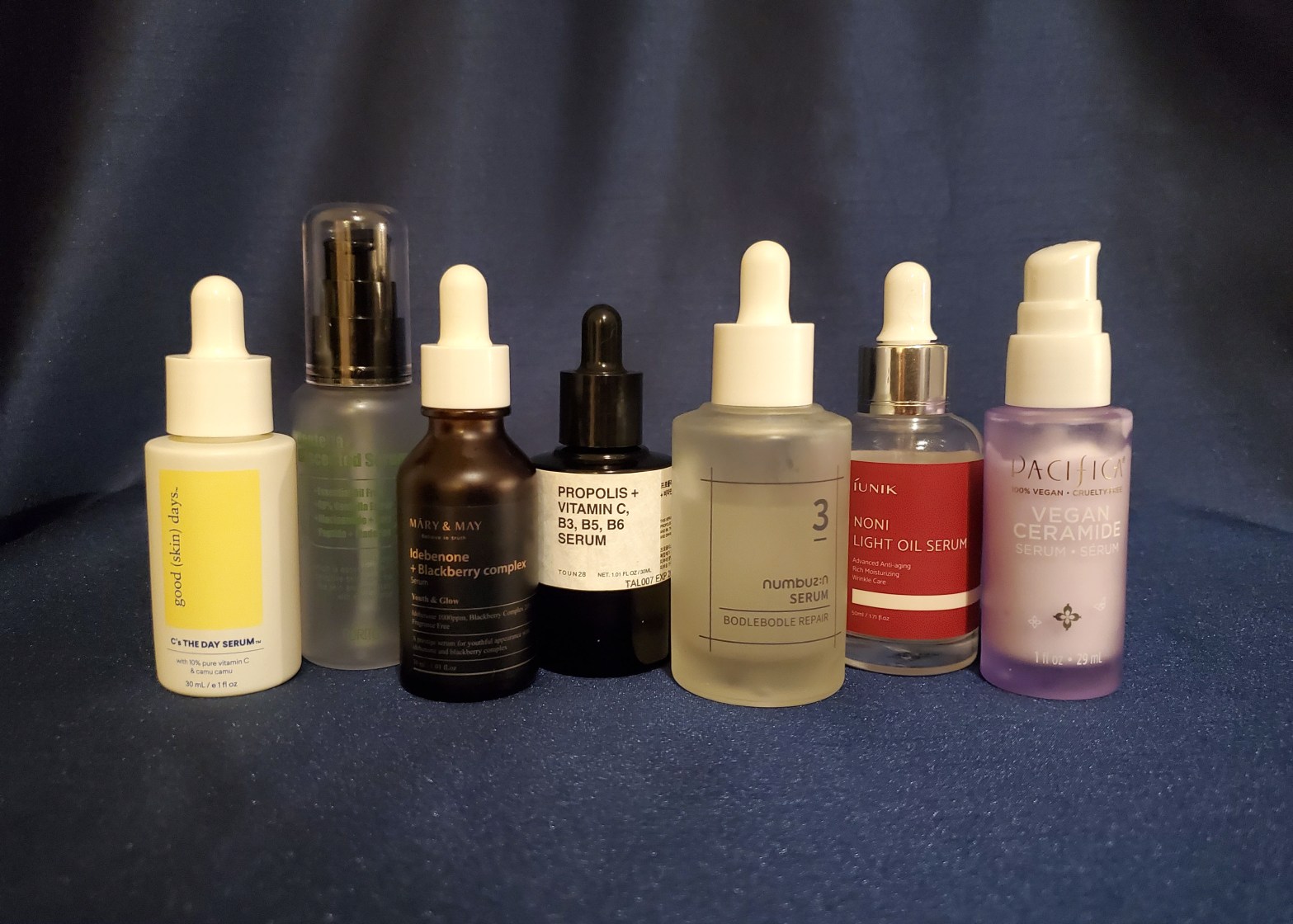
😉 How I’m Doing My Serum Step Lately

I’m using the serums pictured above on a daily basis — no retinol or exfoliating acids shown, since at the moment I’m not using them in serum form.

Typical morning: Good Skin Days C’s The Day Serum; Mary & May Idebenone + Blackberry Complex Serum; Purito Centella Unscented Serum

Morning when I’m feeling fancy: Good Skin Days C’s The Day Serum; Mary & May Idebenone + Blackberry Complex Serum; Toun 28 Propolis + Vitamin C, B3, B5, B6 Serum; Purito Centella Unscented Serum; numbuzin No. 3 Skin Softening Serum

Typical evening: Purito Centella Unscented Serum; Toun 28 Propolis + Vitamin C, B3, B5, B6 Serum; numbuzin No. 3 Skin Softening Serum; Pacifica Vegan Ceramide Serum

Evenings when I’m feeling fancy: Purito Centella Unscented Serum; Mary & May Idebenone + Blackberry Complex Serum; Toun 28 Propolis + Vitamin C, B3, B5, B6 Serum; numbuzin No. 3 Skin Softening Serum; iUNIK Noni Light Oil Serum; Pacifica Vegan Ceramide Serum

Face Off of the Ceramide+Cholesterol+Fatty Acid Serums: Glow Recipe vs RNW vs Stratia

So you want a ceramide serum. Maybe you’re starting to face the dryness that sets in as the years advance; maybe you’re struggling with irritation and a damaged skin barrier from acne, over-exfoliation, or eczema; maybe you’re just feeling the (in my opinion well-deserved) hype. Ceramides are finally having their day as a Big Deal in skincare, and as your friendly neighborhood ceramide-loving skincare fanatic, I swear by a ceramide serum and have some specific opinions on the leading ceramide serums that feature the Skin Barrier Holy Trinity of ceramides, cholesterol and fatty acid.

But First — What are Ceramides? And Why are Cholesterol and Fatty Acids Relevant?

Ceramides are lipids that comprise roughly 50% of the skin’s lipid layer. They are invaluable for keeping the skin barrier intact because they help keep the top layers of the skin glued together. That skin barrier reinforcing function is part of why they’re useful for tackling dryness and dehydration, as well as any sort of skin barrier irritation — they help keep the good stuff in and the bad stuff out.

The three most popular types of ceramides are Ceramide NP, Ceramide AP, Ceramide EOP (yes, these are the three used in CeraVe). Other ceramides that you might have seen on an inci list include Ceramide NS, Ceramide AS and Ceramide EOS. Ceramides that may not look like ceramides on an INCI list include precursors and pseudoceramides. There two ceramide precursors Phytosphingosine and Sphingosine are also becoming more common. Because ceramides are expensive to formulate with, synthesized pseudoceramides are becoming more popular, and will typically have MEA somewhere in the name. Hydroxypropyl Bispalmitamide MEA and Myristoyl/Palmitoyl Oxostearamide/Arachamide MEA are two examples, with the latter being the famed MLE of the Atopalm brand and its child brands Real Barrier, Zeroid and my beloved Derma:B.

Cholesterol, despite being something you want to watch out for in your lipoprotein panel, is actually critical for the skin, and becoming much more common in skincare. It is another type of lipid, and helps reinforce the structure of the membranes of skin cells. While ceramides comprise about 50% of the skin’s lipid layer, cholesterol comprises an additional 25%.

That last 25% of the skin’s lipid layer? Well, most of it (15% of the overall lipid layer) is fatty acids. We naturally break the fat in our food down into fatty acids, such that with the exception of the omega fatty acids, you rarely see them as an explicit addition. The same goes for skincare: many of the oils we know and love in our skincare, like jojoba, avocado, squalane, rosehip and sea buckthorn, just to name a few that you’ll see below, are all great sources of fatty acids.

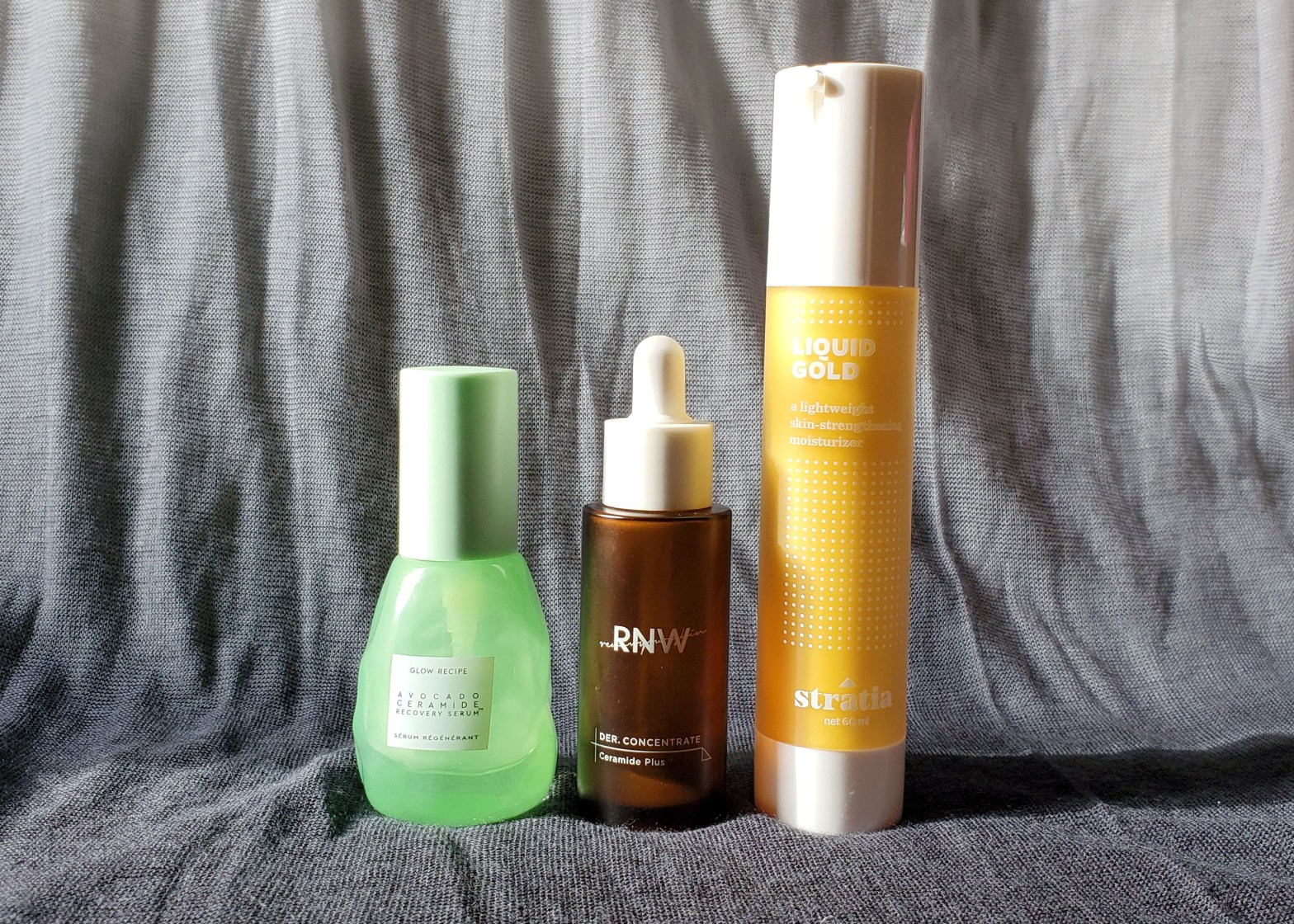
The Products: Glow Recipe Avocado Ceramide Recovery Serum vs RNW Der. Concentrate Ceramide Plus vs Stratia Liquid Gold

Glow Recipe Avocado Ceramide Recovery Serum

Glow Recipe Avocado Ceramide Recovery Serum is one of the first dedicated ceramide serums that folks in the Western market tend to run into, and it’s a popular choice due to its ability to reduce redness and support the skin barrier. This serum includes cholesterol, five ceramides (Ceramide NP, Ceramide NS, Ceramide AP, Ceramide EOP, Ceramide EOS) as well as fatty acid + ceramide precursors Caprooyl Phytosphingosine, Caprooyl Sphingosine.

Per the name of this serum, it also uses avocado oil and avocado fruit extract, which is the source of its characteristic color as well as one of its main sources of fatty acids (this also leans on jojoba). It amplifies its redness reducing benefits with rice protein and rice bran oil, and calming benefits with allantoin. This serum is one I would consider to be in the k-beauty style, as it has a variety of plant extracts for antioxidant benefits.

Glow Recipe Avocado Ceramide Recovery Serum comes in a pump bottle that matches the color of the serum itself. It’s very thin and spreadable, but I found that I needed a pump and a half in order to cover face, neck and chest. Because it’s Glow Recipe, it is relatively pricey: $42 USD / 30 mL.

Water/Aqua/Eau, Glycerin, Jojoba Esters, Persea Gratissima (Avocado) Oil, Persea Gratissima (Avocado) Fruit Extract, Niacinamide, Ceramide NP, Ceramide NS, Ceramide AP, Ceramide EOP, Ceramide EOS, Hydrolyzed Rice Protein, Allantoin, Oryza Sativa (Rice) Bran Oil, Bisabolol, Zingiber Officinale (Ginger) Root Extract, Curcuma Longa (Turmeric) Root Extract, Tocopherol, Palmitoyl Tripeptide-8, Vitis Vinifera (Grape) Fruit Extract, Potassium Palmitoyl Hydrolyzed Wheat Protein, Boswellia Serrata Extract, Populus Tremuloides Bark Extract, Caprylic/Capric Triglyceride, Sodium Phytate, Cetyl Alcohol, Melia Azadirachta Flower Extract, Melia Azadirachta Leaf Extract, Ocimum Sanctum Leaf Extract, Behenic Acid, Cholesterol, Ethylhexylglycerin, Ocimum Basilicum (Basil) Flower/Leaf Extract, Elettaria Cardamomum Seed Extract, Jasminum Officinale (Jasmine) Flower/Leaf Extract, Corallina Officinalis Extract, Sodium Carbonate, Sodium Chloride, Chlorophyllin-Copper Complex (CI 75810), Camellia Sinensis Leaf Extract, Cananga Odorata Flower Extract, Caprooyl Phytosphingosine, Caprooyl Sphingosine, Cucumis Melo (Melon) Fruit Extract, Cucumis Sativus (Cucumber) Fruit Extract, Pyrus Malus (Apple) Fruit Extract, Rose Extract, Rubus Idaeus (Raspberry) Leaf Extract, Ascorbyl Palmitate, Dextran, Hydroxyacetophenone, Xanthan Gum, Butylene Glycol, Carbomer, Cetearyl Olivate, Sorbitan Olivate, 1,2-Hexanediol, Caprylyl Glycol, Hydrogenated Vegetable Oil, Lavandula Angustifolia (Lavender) Flower/Leaf/Stem Extract, Santalum Album (Sandalwood) Wood Extract, Tocopheryl Acetate, Ceteareth-25, Sodium Hydroxide, Phenoxyethanol, Sodium Benzoate.

Ingredients for Glow Recipe Avocado Ceramide Recovery Serum

RNW Der. Concentrate Ceramide Plus

RNW Der. Concentrate Ceramide Plus is the only k-beauty pick on this list and an impressively well-rounded formula. This serum includes cholesterol, five ceramides (Ceramide NP, Ceramide EOP, Ceramide NS, Ceramide AP, Ceramide AS, so a slightly different mix-up than the Glow Recipe), and fatty acids from avocado oil and squalane.

In what I consider to be true k-beauty style, this serum is also chock-full of peptides: Acetyl Hexapeptide-8, Nonapeptide-1, Palmitoyl Tetrapeptide-7, Palmitoyl Pentapeptide-4, Palmitoyl Tripeptide-1, Hexapeptide-9, Tripeptide-1, Copper Tripeptide-1. It also includes a variety of plant extracts and waters for antioxidant benefits. Additional goodies include beta-glucan, niacinamide, and prebiotic fructooligosaccharides.

RNW Der. Concentrate Ceramide Plus has what I consider to be a “classic” ceramide serum texture, in that it’s a bit gloopy and works well in a “cocktail” — mixed in your palm with another serum for spreadability. The price for this 30 mL bottle varies by retailer, but it’s currently listed at $32 on YesStyle.

Water, Dipropylene Glycol, Glycerin, Methylpropanediol, Glycereth-26, 1,2-Hexanediol, Niacinamide, Dimethicone/​Vinyl Dimethicone Crosspolymer, Betaine, Cynara Scolymus (Artichoke) Leaf Extract, Avena Sativa (Oat) Kernel Extract, Ceramide NP, Ceramide EOP, Ceramide NS, Ceramide AP, Ceramide AS, Acetyl Hexapeptide-8, Nonapeptide-1, Palmitoyl Tetrapeptide-7, Palmitoyl Pentapeptide-4, Palmitoyl Tripeptide-1, Hexapeptide-9, Tripeptide-1, Copper Tripeptide-1, Beta Vulgaris (Beet) Root Extract, Eclipta Prostrata Leaf Extract, Algae Extract, Persea Gratissima (Avocado) Oil, Camellia Sinensis Leaf Water, Hydrogenated Lecithin, Cholesterol, Squalane, Tocopherol, Hydrolyzed Hyaluronic Acid, Polyquaternium-51, Glyceryl Stearate, Beta-Glucan, Adenosine, Fructooligosaccharides, Xanthan Gum, Tromethamine, Glyceryl Polymethacrylate, Sucrose Distearate, Acrylates/​C10-30 Alkyl Acrylate Crosspolymer, Butylene Glycol, Silica, Hydrolyzed Zea Mays (Corn) Starch, Caprylyl Glycol, Ethylhexylglycerin

Ingredients for RNW DER. CONCENTRATE Ceramide Plus

Stratia Liquid Gold

Last but never least, Stratia Liquid Gold is possibly when many of us first heard about the need for a ratio of cholesterol, ceramides and fatty acids, as this product explicitly includes all three at 25%, 50% and 15%, respectively. This includes cholesterol, of course, as well as ceramides NP, AP and EOP and phytosphingosine.

The iconic color that gives the product its name comes from sea buckthorn seed oil, which is considered to be a great source of vitamin c, but it also includes rosehip oil, cranberry seed oil and squalane — all those good fatty acids. Niaciniamide, panthenol and urea also help support the skin barrier.

Stratia Liquid Gold is technically a moisturizer (how my husband uses it), though its texture is lightweight enough that many, including myself, can use it as a serum. We’ve gone through a lot of bottles of this, and I find that three pumps cover face, neck and chest. Because of its moisturizer status, this is the most cost-effective option: $27 USD for 60 mL or $49 USD for 120 mL.

Water (Aqua), Propylene Glycol, Ethoxydiglycol, Niacinamide, Polyglyceryl-3 Methylglucose Distearate, Rosa Mosqueta (Rose) Hip Oil, Hippophae Rhamnoides (Sea Buckthorn) Seed Oil, Hippophae Rhamnoides (Sea Buckthorn) Fruit Oil, Panthenol, Dimethicone, Glycerin, Squalane (sugarcane-derived), Cetyl Alcohol, Vaccinium Macrocarpon (Cranberry) Seed Oil, Tocopherol, Camellia Sinensis Leaf Extract, Ceramide NP, Ceramide AP, Ceramide EOP, Phytosphingosine, Cholesterol, Sodium Hyaluronate, Sodium Lauroyl Lactylate, Carbomer, Xanthan Gum, Diazolidinyl Urea, Methylparaben, Propylparaben, Disodium EDTA

Ingredients for Stratia Liquid Gold

The Face Off: When To Use Which

Alright, so that’s the basic breakdown of the ingredients, but which should you use to really make your skin barrier all it can be?

What you’ll get from all three: that good skin barrier support. Truly, I think you can include be doing a lot of great things for your skin barrier but aren’t doing everything you can unless you have ceramides in your routine, whether it’s from a dedicated ceramide product or no. If you’re concerned with dryness, dehydration, irritation or redness, get thee to a ceramide product. That these three include cholesterol and fatty acids, in addition, make them the creme de la creme, in my opinion.

What you’ll get from Glow Recipe Avocado Ceramide Recovery Serum: built-in redness reduction from the color, rice and allantoin, in a lightweight but bougie formula.

What you’ll get from RNW Der. Concentrate Ceramide Plus: extra anti-aging and dehydration-fighting benefits from the peptides and focus on hydrating ingredients.

What you’ll get from Stratia Liquid Gold: a really fun aesthetic, in an inexpensive formula that provides additional vitamins and can multitask as a serum or moisturizer.

So, which one should you pick? If you’re me, the answer is all of them, eventually. If you want to quickly pick something up at Sephora (in the US, anyway) in a redness- and irritation-fighting emergency, or just feel like you’ve got the coin to spend roughly $20 USD on ceramides a month, go for the Glow Recipe Avocado Ceramide Recovery Serum. If you’re a skincare fanatic who wants to try something many folks haven’t heard of while to fight signs of aging and dehydration, you need to try the RNW Der. Concentrate Ceramide Plus (bonus — they have a whole ceramide line). If you’re into a minimal skincare routine (I refuse to normalize the phrase skinimalism) and don’t like heavy layers on your skin, grab the cult favorite Stratia Liquid Gold. No matter what you pick, your skin will thank you.

Honorable Mentions

I try a lot of skincare, so there will certainly be some follow-ups to this post as I dig into all the other ceramide serums I’ve tried and will continue to try. At the moment I intend to do a “Hydrating Ceramide Serum Face Off” with Beekman 1802 vs Ample:N vs Cocokind, and a “Creamy Ceramide Serum Face Off” with Kate Somerville vs Pacifica vs Inkey List. Interested in product comparisons of moisturizers or toners with ceramides? Or any other flavor of Face Off? Let me know.

Other Face Offs

Like this post format? Check out my other posts in this format: Face Off of the Propolis Serums: iUNIK vs COSRX vs Beauty of Joseon, Face Off of the Starter Retinols: Versed vs Stratia vs Indeed Labs, Face Off of the Cica Creams: COSRX vs Isntree, Face Off: Dear Klairs Supple Preparation Unscented Toner vs Etude House SoonJung pH 5.5 Relief Toner and Face Off: Laneige Cream Skin Refiner vs I’m From Rice Toner

* Links to products include affiliate codes, from which I receive store credit if you make a purchase. Please check my home page for additional affiliate and discount codes.

Springing into Warm Weather Skincare

The transitional seasons are, in my opinion, the most fun and beautiful. They also require a bit of navigating, skincare-wise. I did a post in autumn about transitioning into colder weather, Falling into Skin Barrier Support, and while some of this is, well, basically the opposite of that, there are some other things to consider as the weather warms.

Quick Routine Swaps

Switch up your moisturizing step

At least in Colorado, spring can be rocky (yes, that was a mountain pun), as false springs and last minute blizzards can do a real bamboozle. If you, like me, don’t love having a bunch of products of the same type open at once, it can be a real trick to figure out if what you’re opening in early April will still be treating you right in late May. For this reason, I like picking out a light-to-medium weight cream, and using it both AM and PM. In the evening I then add an oil, sleeping pack, or even Vaseline over top to keep my skin extra protected. This does a few things: a) help me go through that moisturizer quicker, in case I need to switch it up again next month, and b) lets me mix and match the amount and type of emollient, occlusive layers depending on what’s up with the weather. Last year I reached for the COSRX Full Fit Propolis Light Cream, this year it’s going to be the Beauty of Joseon Dynasty Cream with the Purito Dermide Cica Sleeping Pack over top, and a bit of Vaseline for my cheeks as needed.

Find a sunscreen you love

Sunscreen is important year-around, as anyone who’s gotten sun damage while innocently going out to shovel the snow can attest (*raises hand awkwardly), but as the days get longer and we spend more time out in the sun, it’s critical to find a sunscreen that you’ll love wearing (and reapplying!) every day. There’s a lot of fear-mongering about sunscreens out there, but the fact is that as long as you’re reaching for something broad spectrum (indicates UVA protection) with at least SPF 30 (indicates decent UVB protection) and actually reapply as directed (to ensure the protective film stays in place), you’re doing great. I personally love K-beauty sunscreens since they’re super lightweight and because most of my physical activity doesn’t require much water resistance. This summer I expect my husband and I to be living in the Isntree Hyaluronic Acid Watery Sun Gel, while downgrading any failed sunscreen experiments to our limbs.

Layer up the toners

Fun fact: this was a tip for transitioning to winter, too. But I think the advice really stands for transitioning into warmer weather, as well. I’m a firm believer in hydrating toners and “seven skins” all the time, and I’ve written about my love of toners elsewhere, so here I just want to get into what to change up with your toner routine. Toners are a lovely, lightweight way to add lots of hydration and helpful ingredients to your routine without adding any feeling of heaviness or greasiness (which, helloooo these warmer days will thank you for it). I personally break my toning step out into four different products: a first essence, a hydrating toner, a treatment toner and an essence. The first essence adds incredibly lightweight hydration and nourishment, the hydrating toner I can layer up for additional hydration without feeling like I’m bleeding money, the treatment toner lets me add some sort of antioxidant or anti-inflammatory set of ingredients, and the essence just doubles down on whatever issue I’m tackling with that treatment-type toner. My current round-up, in order, is SK-II Facial Treatment Essence, Round Lab 1025 Dokdo Toner, Sioris My First Essener and Benton Snail Bee High Content Essence.

Introduce a double cleanse

Just as we needed to go for a more gentle cleansing routine for winter, as we start layering on the sunscreen (and sweat, let’s be real), you might need something a bit more robust. If you’re not already double cleansing, this may be the time to start. While quite popular for makeup wearers, as an avid mountain biker I can attest that nothing takes off a layer of caked grime quite like a good cleansing balm, and that water cleanser after feels downright refreshing. What you might like in a first cleanse — be it a micellar water, cleansing oil or cleansing balm — will vary by your personal preference, so I recommend starting out with minis to make sure you enjoy what you’ve picked. I recently picked up a full-size of the Farmacy Green Clean Makeup Removing Cleansing Balm to use in the coming months, and am still loving the gentle cleanse of the Tatcha The Rice Wash as my second cleanse.

Ingredients Spot Check

If you’re into the “turning and learning” part of skincare internet, there are a few ingredients that you’ll want to keep your eye out for to really take your skin to the next level now.

Love antioxidants

Antioxidants are a great addition year around, but they’re especially nice when we’re exposed to more light and more pollution, as they help reduce oxidative stress caused by free radicals, which may sound like fun progressive politicians but are actually unstable atoms and molecules that could use some spare electrons to minimize their potential for damage. An antioxidant product in the morning, along with your sunscreen, can really set you up for success. Vitamin C is an incredibly popular antioxidant for a variety of reasons, and indeed its power as an antioxidant is part of why Ascorbic Acid has a propensity for oxidizing and turning brown. If your skin can’t quite handle Ascorbic Acid or Vitamin C derivatives, I recommend reaching for Resveratrol, Pycnogenol, CoQ10, Polyphenols, Green Tea and other plant extracts (but not essential oils!).

Love a combination of sunscreen filters

Different sunscreen filters, whether chemical or mineral, are rated to block specific wavelengths of UV radiation. This is why, for example, you can see an SPF rating (UVB) without a broad spectrum label or PA rating (UVA) — depending upon the filters used, the sunscreen you’re looking at may or may not have it. A combination of filters can give you a high level of protection across the spectrum. This will certainly be an incomplete list, but popular UVA filters include Avobenzone and Uvinul A Plus; popular UVB filters include Titanium Dioxide, Oxybenzone, Octinoxate, Octocrylene and Homosalate; and popular filters providing both UVA and UVB protection include Tinosorb S and Zinc Oxide.

General Skincare Tips

These are some tips that will cost you nothing and are good to do year around, but you might definitely want to consider as the days get longer.

Keep an eye on your actives

While a proper approach to sun protection should keep you safe even with a routine full of actives, it never hurts to make sure you’re not working against yourself. Though I don’t believe you need to stop using a retinoid in the summer (indeed, Vitamin A is a great antioxidant), you might want to avoid going through the stress of retinization and purging when you’re getting a lot of sun exposure, as that inflammation can lead to things like PIE and PIH. Likewise, I always try to avoid reaching for a strong exfoliating mask when I know I’m going to be out in the sun a lot the next couple days, as I want that extra bit of dead skin there to help protect me.

Don’t forget your hands, neck and chest

I’m always a proponent of rubbing extra product into your hands, but as our hands get the next-most sun exposure as our faces, make sure that they get sunscreen applied to them as often (or more, with the need for regular hand washing) as your face does. Likewise, remember that your skincare should be going well onto your chest. I, for one, have been the victim of a v-neck sunburn on several occasions, and one of my goals for this year is to avoid that indignity.