July & August Openeds Reviews

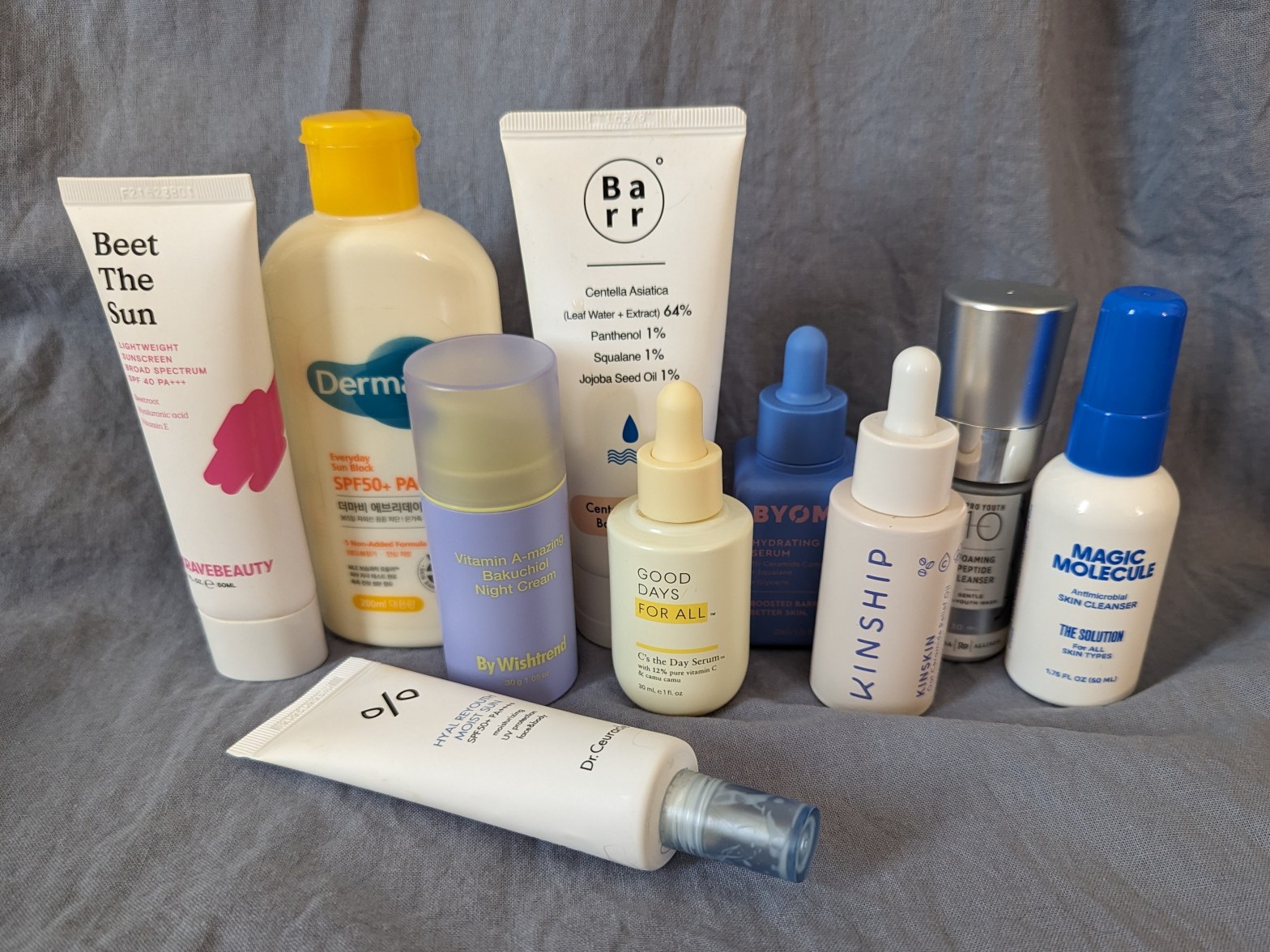
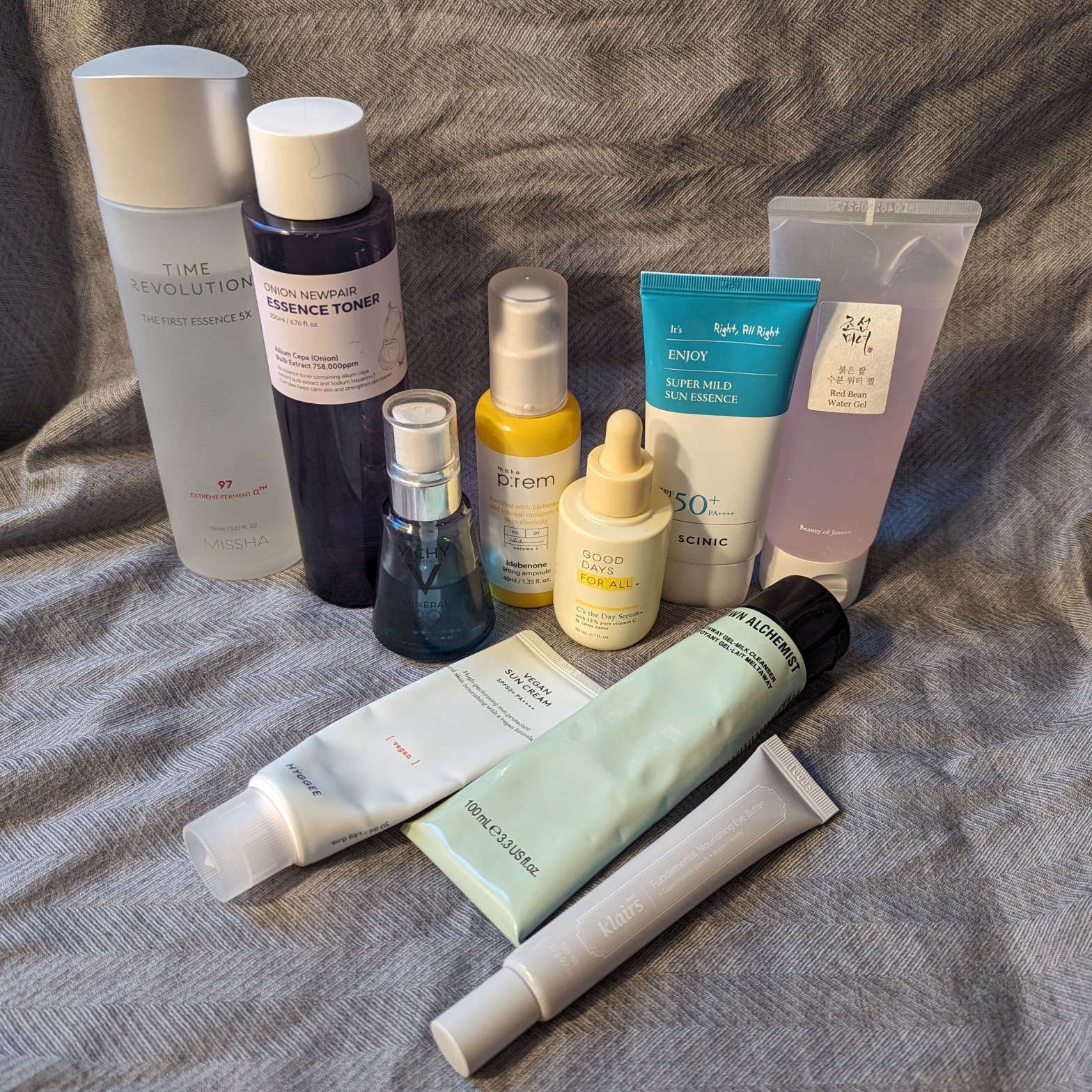
You know how I’ve been talking about how wild life’s been? Well, imagine me gesturing broadly right now. Given how truly off-the-rails things have been, I’m doing my July and August openeds in one post (it was the way to get them out before September, so it’s a win, right?). And yes, that is a dog fluff on the lid of the Isntree essence toner. And yes, that backdrop is extremely wrinkly. It is what it is. Anyways, both months featured a bit of travel around the great state of Colorado, and a lot of mountain biking. As such, dealing with the sun and the dryness took center stage.

Essences

🍢 Missha Time Revolution The First Essence 5X

The Missha First Treatment Essence was my first SK-II dupe, and it remains my favorite in its category — so I had to try Time Revolution The First Essence 5X, the latest iteration. It has 97% desert cica yeast ferment, which I’m assuming is the usual saccharomyces with a bit of extra “zhuzh”. In addition, this includes some niacinamide for brightening and ceramide NP for strengthening. I always find that my skin feels much more deeply hydrated and my pores appear smaller when using a first essence, particularly the one from Missha, and I’m glad to have it in my routine again. I use one layer (sometimes two!) as the first post-cleanse step of my morning and evening routine.
Opened: August
Price: $54 USD / 150 mL

πŸ§… Isntree Onion Newpair Essence Toner

I was skeptical when I first heard about the Isntree Onion Newpair Essence Toner but I love Isntree, I love toners and hey, I’m down with onions. Notionally, the 75% muan red onion extract is to help with acne, but a lot of the reviews of the line mentioned how it was good for brightening — and given the tranexamic acid, niacinamide and sodium ascorbyl phosphate (a vitamin C derivative), I’m willing to believe it. It’s a very classic toner texture, so the “essence” piece of this is more for the percentage of onion than speaking to a particular step in a routine. I’ve been using two layers, AM and PM.
Opened: August
Price: $25 USD / 200 mL

Serums

πŸ’§ Vichy Mineral 89 Hyaluronic Acid Face Serum

I got the Vichy Mineral 89 Hyaluronic Acid Face Serum for my husband to replace the hyaluronic acid serum he was upsold at our spa. Turns out — he likes it a lot better! Even before he knew it was half the price. I’ve tried their probiotic serum, but this one is much loved by the modmins of Skincare Fanatics, and being the “og” of the Vichy serum line I wanted to try it eventually. It goes on, and stays, smooth — no pilling, like some HA serums (including the expensive one from the spa). Two pumps of this is all you need.
Opened: August
Price: $20 USD / 30 mL

πŸ’› make p:rem Idebenone Lifting Ampoule

The make p:rem Idebenone Lifting Ampoule, despite having idebenone in its name, is in my routine for all of its ceramides (NP, AS, AP, NS and EOP) and is largely kakadu plum extract. Idebenone, essentially a synthesized alternative to coenzyme Q10, doesn’t need to be at high percentages, and here is at 1%. This is a creamy serum, and feels very well rounded with its additional hyaluronic acid, plant extracts, beta glucan and cholesterol. I use two pumps of it as my last serum in the AM and PM, since I like the antioxidant support for morning and the skin barrier support for evening.
Opened: July
Price: $20 USD / 40 mL

πŸ’ Good Days For All C’s The Day Serum

I was a fan of the Good Days For All C’s The Day Serum when it was still the Good Skin Days C’s The Day Serum, and this is my second bottle of the rebrand. The rebrand involved a reformulation to be 12%, rather than 10%, ascorbic acid, and a notable increase in stability. It’s very gentle, non-tacky and, importantly, does NOT smell like hot dog water. In addition to ascorbic acid, this has licorice root extract, niacinamide, magnesium ascorbyl phosphate (a vitamin C derivative), arbutin, camu camu extract and even idebenone, which can all help brighten. I use it as my first serum in my morning routine.
Opened: July
Price: $26 USD / 30 mL

Sunscreen

β˜€οΈ Hyggee Vegan Sun Cream SPF 50+ PA++++

I initially got the Hyggee Vegan Sun Cream SPF 50+ PA++++ when it was the first of the reformulated Korean sunscreens of 2021 which was a purported dupe for Krave Beauty’s The Beet Shield. This does, indeed, use beet root extract. It’s a moisturizing texture and uses modern chemical filters. While normally I would be more apt to use it in the winter, given that I’m using lighter moisturizers this summer, having its weight on my skin is comforting.
Opened: July
Price: $17 USD / 50 mL

Scinic Enjoy Super Mild Sun Essence

The Scinic Enjoy Super Mild Sun Essence is SPF50+ PA++++ as well, and we opened it shortly after my husband emptied his Isntree Hyaluronic Acid Watery Sun Gel. As such, I can’t help but feel like it’s a heavier, greasier version of that sunscreen, though in fairness it IS about half the price. That is, of course, not to say it’s as greasy as a US sunscreen — it is still a k-beauty SPF, after all, and has the elegance and modern chemical filters associated with that.
Opened: August
Price: $8 USD / 50 mL

Other

🫘 Beauty of Joseon Red Bean Water Gel

I got the Beauty of Joseon Red Bean Water Gel through the YesStyle review program, in exchange for a review which I am very overdue on (this is not that review). This is a new line from Beauty of Joseon, from which I already have and am enjoying the mask. This moisturizer is designed for oily skin, and has 44% haenam red bean extract, as well as three peptides. I, of course, do not have oily skin. But I do like a lot of layers, and so if I use a lighter moisturizer in combination with, say, a creamy serum like the one from make p:rem, and a moisturizing sunscreen like the one from Hyggee, I can very nearly pull it off. I will say, though, I haven’t been reaching for it much — sometimes I’ve been been foregoing moisturizer in the morning, as this doesn’t feel like it’s doing much, it’s just an additional hydrating layer.
Opened: July
Price: $18 USD / 100 mL

πŸ₯› Grown Alchemist Meltaway Gel-Milk Cleanser

I also received the Grown Alchemist Meltaway Gel-Milk Cleanser in exchange for a review on the brand’s website, which I absolutely dropped the ball on. Sorry, Grown Alchemist! I promise I’ll get it in, but I’m sure I’m already struck from the review list. This cleanser reminds me a bit of the (now discontinued) Biossance Squalane + Elderberry Jelly Cleanser. It goes on dry skin, then gets emulsified and rinses off — so if you don’t want a double cleanse, this is a great option. I’ve also used this as a classic second cleanse (on damp skin) for which it also works well. This rinses much cleaner than other water-based cleansers, in my opinion, and it leaves the skin feeling beautifully soft.
Opened: August
Price: $50 USD / 100 mL

πŸ‘οΈ Klairs Fundamental Nourishing Eye Butter

Have I mentioned it’s been a rough year? Well, I’m not a big eye cream wearer, but after some comments about how tired I looked, I figured I might as well give the Klairs Fundamental Nourishing Eye Butter a try, since it was gathering dust in my skincare stash. It’s too soon to really see any improvement, and realistically a good night’s sleep does more for the appearance of my eye area than any topical could, but I’m hoping that with time the four peptides, as well as anti-oxidants like caffeine and green tea, make the effects of a good night’s sleep last. Because this doesn’t have any actives in it, I’ve also been able to bring back my old hack of using eye cream on my lips and tech neck lines, too.
Opened: August
Price: $24 USD / 20 g

July Empties Reviews

July was rough. June was rough. May was rough. August is shaping up to be rough so far. Is there an end in sight in September? I sure hope so — if nothing else, there’s a trip to Japan. July involved a huge 10 mile hike, lots of mountain biking, and a trip to the sun-blasted Western Slope of Colorado for a wedding. As such, this month had a lot of sunscreen empties.

Sunscreen

β˜€οΈ Isntree Hyaluronic Acid Watery Sun Gel

If you haven’t already tried the Isntree Hyaluronic Acid Watery Sun Gel, I strongly encourage you to. It’s become a cult classic for good reason: it uses modern chemical filters, goes on non-greasy, leaves your skin feeling comforted, and leaves no white cast. The seven types of hyaluronic acid are, thankfully, not a problem even in an arid environment, and the ceramide NP, pinus pinaster, cica and heartleaf never hurt. Even my husband loves it, and he doesn’t like the feeling of things on his skin. It’s no wonder we bombed through a tube in a month, during the height of summer in Colorado.
Price: $17 USD / 50 mL
Opened: June ’23
Rating: 10/10

πŸ’ͺ Kaine Green Fit Pro Sun SPF 50+ Sunscreen

I’m supposed to review the Kaine Green Fit Pro Sun SPF 50+ Sunscreen because I got it through the YesStyle Influencer program, and I have yet to do it (this isn’t it). This is a hybrid sunscreen, with modern chemical filters as well as titanium dioxide. This, thankfully, means it’s not drying like it would be if it had zinc oxide. However, this does not avoid it having a white cast. I ended up downgrading it to body sunscreen pretty immediately, where I don’t hate it, but notably any build-up (say, in elbow creases) goes purple pretty immediately. That said, the protection and staying power was pretty good, and I didn’t hate using it on mountain biking adventures.
Price: $16 USD / 55 mL
Opened: June ’23
Rating: 7/10

β˜€οΈ Innisfree Intensive Leisure Sun Stick

I fell in love with sun sticks last summer, but it took me a while to finish the Innisfree Intensive Leisure Sun Stick. It’s an SPF 50+ PA++++, and I’ve definitely never had any issue with protection with it, thanks to the modern chemical filters. However, I didn’t love it for face — it felt weirdly greasy, to the point that it oddly felt like sweat would become trapped on my upper lip, underneath it. I really like it for body sunscreen, however. I would roll it out a fair way, then swipe until it’s all the way back down to the edge of the tube.
Price: $14 USD / 18g
Opened: September ’22
Rating: 7/10

Not Sunscreen

🧼 Farmacy Clean Bee Ultra Gentle Facial Cleanser

This bottle of Farmacy Clean Bee Ultra Gentle Facial Cleanser has been a staple in our shower over the last two years. I initially got it for my husband, as I figured that the cute packaging and the honey smell would encourage him to use it. It was definitely more effective at that when kept in the shower than on the counter, but realistically neither of us think face washing is the most fun part of a skincare routine. Eventually, I decided to just use it up. One pump of this goes a long way, so it makes sense that it’s been millimetering down. It’s not as gentle as the name might make you think, and the smell is more honey for anyone near you than yourself. It’s definitely not stripping, though.
Price: $28 USD / 150 mL
Opened: October ’21
Rating: 7/10

🍹 Beekman 1802 Golden Booster Amla Berry Vitamin C Brightening Serum

If it feels like you just saw my review of Beekman 1802 Golden Booster Amla Berry Vitamin C Brightening Serum, it’s because you did — the bottle is smol. It’s intended to be mixed into the Beekman 1802 moisturizer, which I don’t have, but I do recommend cocktailing it, as otherwise it has basically no slip to it. I generally mixed it with slightly creamier formulas, as this generally blended the best. It was … fine. I didn’t notice any change, when using it. Notionally, the hero ingredients here are sources of vitamin C and vitamin A which more sensitive skin types might be able to use. Unless you’re in the particular venn diagram of “has sensitive skin”, “can use plant extracts and oils” and “doesn’t mind dropping cash” I think it’s a miss.
Price: $28 USD / 15 mL
Opened: June ’23
Rating: 3/10

πŸ‘½ Good Light We Come In Peace Probiotics Microbiome Serum

Good Light’s marketing is pretty fabulous, and I’m all about the skin microbiome, so I snatched their We Come In Peace Probiotics Microbiome Serum earlier this year. Despite the name, this doesn’t have as many probiotics on its inci list as you might expect (just lactococcus ferment lysate), but it also has bakuchiol and carrot seed oil. It’s lightly fragranced, due to tansy flower oil, and has a soothing creaminess. I could see acne-prone skin types loving this, and in fairness I think this is generally Good Light’s target market. It’s usable AM and PM, and though I didn’t find that my skin was more calm with it, I can imagine it being a helpful part of a routine for folks who struggle with more inflammation.
Price: $24 USD / 35 mL
Opened: May ’23
Rating: 8/10

🐝 Cosrx Full Fit Propolis Honey Overnight Mask

I had been eyeing the Cosrx overnight masks since I first got into skincare, and I’ve finally made it through a tube of the Cosrx Full Fit Propolis Honey Overnight Mask. I love Cosrx, I love the bee trifecta (propolis, honey and royal jelly extracts), and I love sleeping masks. That said, I’ve had other sleeping masks I like better: this one was neither incredibly soothing (like the A’pieu madecassoside one I love so much that’s been discontinued) or incredibly nourishing (like the Kiehls squalane). It’s likely great if you don’t have propolis in another format, and want to double it up as an AM moisturizer, which did work out well. As a sleeping mask, however, it didn’t feel like it did too much.
Price: $18 USD / 60 mL
Opened: April ’23
Rating: 8/10

June Openeds Reviews

Has my life calmed down? No. Has it stopped raining in Colorado? Also no. Am I managing to make it outside when it’s not? Yes. Am I managing to do my skincare routine more often? Also yes. Because skincare is both a self-maintenance and a self-care endeavor for me, I’ve been trying to make more of an effort lately, so even on days when I’m really not feeling it I manage to squeak in a bit of a routine, even if it’s a pretty low effort one.

Sunscreen

🌸 OMI Menturm Tint Lip Sakura SPF 20 PA++

I really enjoy k-beauty lip sunscreens, but I usually go for Rohto Mentholatum, so the OMI Menturm Tint Lip Sakura SPF 20 PA++ is a new formulation for me. This has a very classic chapstick feeling, with plenty of slip. In addition to being a lip spf, it’s also got a bit of a tint — very specifically, the sort of tint that notionally is activated by the pH of your lips. On me, this makes the clear balm go to a sheer pinky pink, much in line with the color of the tube. Because I tend towards rather red lips naturally, it’s not too noticeable, but your mileage may vary.
Price: $6 USD / 3.5g

😎 Dewytree Urban Shade Cool Calming Sun Stick

It’s summer, and so though I’ve got one sun stick open already (Innisfree), I opened up the Dewytree Urban Shade Cool Calming Sun Stick because more outdoor activities means more random places I need to stash to-go sunscreen. As the name implies, this sunscreen has a lot going on with it. I’m not sure where the Urban Shade is coming in, but there’s definitely some cooling going on here. Indeed, this has strong menthol vibes, without having menthol, as it has both a strong smell and a cooling effect. The calming comes from the niacinamide, aloe, rice bran oil and panthenol, among other ingredients. This is definitely a more oily-feeling sun stick, and though the cooling effect is real, it’s definitely got a vary narrow appeal.
Price: $15 USD / 20g

β˜€οΈ Isntree Hyaluronic Acid Watery Sun Gel

You’ve tried the Isntree Hyaluronic Acid Watery Sun Gel. I’ve tried the Isntree Hyaluronic Acid Watery Sun Gel. My husband has tried the Isntree Hyaluronic Acid Watery Sun Gel. Well, this is our new bottle. This is a k-beauty sunscreen made with the modern chemical sunscreen filters, seven types of hyaluronic acid (which actually works in Colorado! huzzah! HA in a sunscreen, somehow, not an issue), and some other delicious ingredients, like ceramide NP, pinus pinaster, cica and heartleaf. Long may it be in production!
Price: $17 USD / 50 mL

πŸ’ͺ Kaine Green Fit Pro Sun SPF 50+ Sunscreen

I received the Kaine Green Fit Pro Sun SPF 50+ Sunscreen through the YesStyle Influencer program in exchange for a review, and this ain’t that review, because that I put on Instagram. I usually wait a fair bit after opening a product to review it, but this one I feel pretty read to pass judgment on. I was very curious about this sunscreen because it’s a hybrid, with both modern chemical filters as well as titanium dioxide. I was hoping, because there was no zinc, that it wouldn’t be drying and that it wouldn’t have a white cast. Well, it’s not drying, but it does have a white cast. It also pills if I have pretty much any skincare underneath it. It functions alright as a body sunscreen, but that white cast becomes pretty evident any place where the skin tends to crease (hello, purple elbows).
Price: $16 USD / 55 mL

Serums

🍹 Beekman 1802 Golden Booster Amla Berry Vitamin C Brightening Serum

I picked up the Beekman 1802 Golden Booster Amla Berry Vitamin C Brightening Serum when it was half-off through Ulta, and I have to say that’s probably the way to buy it. This serum is pretty preciously priced for a vitamin C that’s getting that vitamin C from a fruit extract (amla berry), a plant extract (holy basil) and a derivative (ascorbyl palmitate), and has to be cocktailed with another product to have any amount of slip. In Beekman 1802’s defense, this is explicitly how they recommend using this booster, which is why they call it a booster. I do find it interesting that this also includes carrot root extract and seed oil, as that’s a source of vitamin A — theoretically, if you’re a more sensitive skin type that can use plant extracts and oils, this could be a nice source of both.
Price: $28 USD / 15 mL

🐝 Dr Ceuracle Royal Vita Propolis 33 Ampoule

Long-time readers know that I take a Pokemon approach (gotta catch ’em all!) to propolis serums — gotta catch ’em all! — and one of the last few on my tour is the Dr. Ceuracle Royal Vita Propolis 33 Ampoule. This has 33% propolis extract, as well as royal jelly, though it lacks the honey that would make it round out the “bee trifecta” as I call it. This really focuses on antioxidant support by adding green purslane extract, sea buckthorn fruit extract, niacinamide and other extracts. It’s a rather watery formula, likely because the percentage of propolis is low compared to many of the other serums and ampoules out there. It’s been about a month since I’ve had a propolis serum (though I have been using a propolis sleeping mask most nights) so I’m looking forward to seeing the glow in my skin amp up again.
Price: $48 USD / 30 mL

🌲 iUNIK Noni Light Oil Serum

I got the iUNIK Noni Light Oil Serum in a BOGO Black Friday sale almost two years ago, and so this is my second time opening it. Noni, or morinda citrifolia, is a type of evergreen whose fruit (which, of course, looks like a cone) makes an anti-inflammatory, hydrating extract. This serum isn’t actually an oil, but rather a slightly creamy serum, thanks to the addition of macadamia nut, jojoba seed and olive oils. This has been a nice serum to reintroduce during summer, when I want a bit of extra moisturization and hydration without it feeling too heavy.
Price: $20 USD / 50 mL

πŸ’‘ Naturium Multi-Bright Tranexamic Acid Treatment 5%

With increased sun comes increased sun damage, so I picked up the Naturium Multi-Bright Tranexamic Acid Treatment 5%. I’ve used tranexamic acid, which is known for its ability to fade dark spots and melasma, before in the Glow Recipe Guava Vitamin C Dark Spot Serum, so I was keen to try it in a more focused formula. This is combined with encapsulated kojic acid, a tyrosinase inhibitor which should help sun damage from forming in the first place, as well as alpha arbutin and acetyl glucosamine. This is an odd, thicker formula, likely because of the inclusion of kaolin, but it layers with no issue. For the time being I’ve mostly been using it in the mornings, or in the evenings after long adventures outside when I don’t want to stress my skin with AHA or retinoids.
Price: $22 USD / 30 mL

😴 UNPA Lacto Cica Locking Serum

I don’t always go in for toner pads, but sometimes life is doing you a big bamboozle, so I ordered the UNPA Lacto Cica Locking Serum ones. I find toner pads really nice for evenings when I’m just not up to cleansing — though it’s no substitute for a good cleanse — or for mornings when I find myself waking up grubbier, like when it’s humid and my house has been upended for weeks at a time. These have a variety of postbiotics, in the form of bifida ferment filtrate and lysate, lactobacillus ferment lystate, lactococcus ferment lysate, and saccharomyces extract, which I always love to see. The cica in this comes from centella leaf extract, as well as madecassoside and asiaticoside. These are generally quite hydrating and calming, and a great shortcut to an easier morning.
Price: $34 USD / 85 pads, or 145g

Moisturizers

πŸͺ· Rovectin Clean Lotus Water Cream

Having dry skin, I’m not usually a water cream person, but I love Rovectin’s line (the toner and sheet mask, anyway) and Colorado’s been so unexpectedly humid for the past month so it seemed worth trying the Rovectin Clean Lotus Water Cream for both AM and PM use. This is a pretty stripped down formula, with lotus flower extract being the main hero ingredient, supported by glycerin, niacinamide, sweet almond oil, panthenol and prebiotics. Given that the sheet mask immediately leaves my skin looking better, and the toner was pretty deeply hydrating, my hopes are high for this moisturizer — but frankly, I still haven’t used it enough to see any particular results beyond moisturization, because I’m still working my way out of the Skincare Struggle Bus.
Price: $20 USD / 60 mL

πŸ‘‘ Stratia Liquid Gold

Stratia Liquid Gold is a cult classic, and I highly recommend it for the person who could use some skin barrier support but doesn’t like the feel of products on their skin — like my husband. He uses it as a moisturizer, both AM and PM (when he remembers to do his routine, of course). I find it a bit lightweight for that, though a few layers of it works as a pinch, but do use it as a ceramide serum when we’re packing light on a trip. This has the skin barrier trifecta of ceramides, cholesterol and fatty acids, as well as antioxidant, skin-loving ingredients like niacinamide and sea buckthorn oil.
Price: $27 USD / 60 mL

Other

Β½ Naturium Half Step Flash Facial Cleansing Mask

While I enjoy an exfoliant I can use on a regular basis, sometimes my skin just wants an exfoliating mask to really have a good reset, and having tried a bunch of others on the market (Peach & Lily, Versed, Then I Met You … still not The Ordinary, on principle), I wanted to give the Naturium Half Step Flash Facial Cleansing Mask a try. The reason this is a “half step” is that, unlike other exfoliating wash-off masks, this mask is explicitly intended to go between a first and second cleanse, on either wet or dry skin. This is partially a clay mask, so I went with damp skin — those with sensitive skin will want to do dry, because it also includes lactic and glycolic acids. I leave this on for five minutes, as directed, and then rinse off and continue with my second cleanse. I didn’t find the clay (kaolin and bentonite) in this to be drying, in part because five minutes is simply insufficient for them to dry down. I didn’t notice an immediate improvement in skin texture, as happens with some wash-off masks, but I’m excited to use it more.
Price: $20 USD / 62.3 g

🌚 PSA Midnight Courage Rosehip & Bakuchiol Retinoid Night Oil

I picked up the PSA Midnight Courage Rosehip & Bakuchiol Retinoid Night Oil during one of their BOGO sales, because I’m pretty keen on bakuchiol. It, along with rosehip oil, is considered a retinol alternative, and is safe for daily use, even in the morning. There is an actual retinoid in here as well, in the form of hyerodypinacolone retinoate. This is a proper facial oil, with a sunflower seed oil and safflower seed oil base, but the antioxidant power of the vitamin A sources is bumped up by black currant, pomegranate, arctic cranberry and baobob seed oils, as well as ubiquinone (CoQ10). It seems a bit like playdoh, which isn’t ideal, but it doesn’t feel to heavy.
Price: $46 USD / 15 mL

πŸͺ„ Magic Molecule The Solution

Did I open a bottle of Magic Molecule The Solution two months ago? Yes. Did I empty one one month? Yes. Did reopen one last month? Also yes. Are there four more bottles out in my mail waiting to be rescued? Also also yes. This is a sprayable hypochlorous acid solution which is a new go-to in our household and is, at some point, likely to not merit mentioning in our household’s skincare openeds and empties anymore simply because it’s such a staple. I spray it on my face as a bit of an anti-acne solution, as well as to pretend I cleansed on lazy days. We also spray it on bug bites and itches.
Price: $25 USD / 100 mL (in two 50 mL bottles)

June Empties Review

Nothing says that it’s finally summer in Colorado like suddenly emptying three sunscreens. It’s generally been pretty humid, though, due to tons of rain (and hail), which means that in some cases I’m pretty glad to have some of these heavier-feeling products out of my routine, even with my dehydrated, dry skin.

Sunscreen

β˜€οΈ Dr. Ceuracle Hyal Reyouth Moist Sun

At first I hated the Dr. Ceuracle Hyal Reyouth Moist Sun, and was glad that I had gotten it for free through the YesStyle Influencer program and hadn’t spent my hard-earned coin on it. But I’ll admit, it grew on me. At first it felt both drying and heavy, but I found that by cutting down on my AM routine, it didn’t feel quite so suffocating. Where it really shown, however, was as a body sunscreen, because it truly did feel weightless there. This does have some fragrance, which some folks might not love, as it’s definitely a very sunscreen-y smell. The little applicator is nifty, but it does mean that in high elevations the product can easily leak into the cap itself, so maybe don’t take this one up to 7k feet, like I did.
Opened: April
Price: $19 USD / 50 mL
Rating: 8/10

πŸ’– Krave Beauty Beet The Sun

Krave Beauty’s Beet The Sun is the reformulation, using US FDA-approved chemical filters, of their Beet Shield, which was my gateway sunscreen back in the day. This is an SPF 40, with homosalate, octisalate, avobenzone and octocrylene, and unlike many sunscreens made with this formula, it really does feel lightweight. I did a Face Off between Beet The Sun and Beet Shield a while back, so I encourage you to go check it out. I don’t love it as much as the original, I’ll admit, but I like it well enough that if, for some reason, I’m unable to order chemical sunscreens with the modern generation of filters from overseas, I would absolutely repurchase.
Opened: March
Price: $20 USD / 50 mL
Rating: 9/10

β˜€οΈ Derma:B – Everyday Sun Block SPF50+ PA++++

Have I had Derma:B – Everyday Sun Block SPF50+ PA++++ open for more than a year? Yes. Is it an absolutely enormous bottle? Also yes. I’m a big fan of Derma:B for body products, and the Everyday Sun Block is tricky to find, but it’s occasionally available on YesStyle (fun fact: they actually just had it as a freebie from the brand, with the purchase of $25 in product, so guess who’s going to be trying it again). This feels and smells more like a US sunscreen than any of the other Korean sunscreens I’ve tried, but it’s still substantively more comfortable, and given that we predominantly use it for body, it’s not an issue at all. This uses all FDA-approved sunscreen filters, and includes the Derma:B patented synthetic ceramide, as well as prickly pear, cucumber, aloe vera and chamomile extracts. It passes the husband test, so it’s definitely nice and wearable.
Opened: April ’22
Price: $15 USD / 200 mL
Rating: 8/10

Serums

πŸ’ Good Days For All C’s The Day

If you’ve been waiting to snatch the reformulation of C’s The Day because you’ve been concerned about oxidization — concern yourself no more, I can confirm they fixed the issue. With the previous formulation, I would typically see oxidization at the end of the first month, with it being pretty fully brown by the end of the bottle. But after being opened for three months, this only began to show the faintest hint of yellow. Given that this actually has a higher ascorbic acid percentage (12%, up from 10%), it shows the extent to which they went to stabilize it. It still includes my favorite additional brighteners of licorice root, niacinamide and camu camu extract, but now has magnesium ascorbyl phosphate (MAP, a vitamin c derivative) and various plant extracts for some extra anti-oxidant support. I will say, however, that this did sometimes oxidize on my actual face — towards the end of the bottle, I took extra care to blend it at the edges of my hairline, or I occasionally got some brown buildup. I’m also a skincare maximalist, though, so it’s likely that if this is your only AM serum, you may have no issues on that front.
Opened: March
Price: $26 USD / 30 mL
Rating: 10/10

πŸ’§ Byoma Hydrating Serum

Somehow Byoma has figured out how to formulate inexpensive ceramide-full products, and their Hydrating Serum is a prime example. This is not what I would typically think of as a hydrating serum at all, however — instead this is really a drugstore ceramide serum. It’s got a creamy texture, and has ceramide, cholesterol and fatty acids (the skin barrier trifecta). The hydration from this, insofar as it exists, is from the glycerin and lactic acid.If you’re looking for a serum for hydration, this is probably not your best choice, especially if you have normal to oily skin. The packaging is cute, and the price point is fabulous, but as far as ceramide serums go there are ones out there that I feel do more.
Opened: April
Price: $16 USD / 30 mL
Rating: 8/10

Creams

πŸ’œ By Wishtrend Vitamin A-mazing Bakuchiol Night Cream

This is the second bottle of By Wishtrend Vitamin A-mazing Bakuchiol Night Cream, and I do highly recommend it for anyone looking to try out retinal in a gentle formulation. This reminds me a bit of the Stratia Night Shift, in that you definitely could use this as a night cream if you wished, and since it’s been so humid I have sometimes only been using this and a sleeping mask after my serums in the evening. In addition to retinal, this has bakuchiol, niacinamide, palmitoyl tripeptide-8, beta glucan, centella extract and ceramide NP, and when my esthetician said how much better my skin was looking since she started working with me (it’s been about a year), I thought through my skincare history and realized that, beyond generally working on my skin barrier health, it almost certainly had to be this. I’m moving onto a stronger retinal now (this one is .03%, the one I’m going to open is .05%), but I’ll almost certainly be back some day.
Opened: April
Price: $33 USD / 30g
Rating: 10/10

πŸƒ Barr Centella Calming Barrier Cream

I’ve been working my way through much of Barr’s Centella Calming line, including the Barrier Cream. It’s lighter than a lot of barrier creams, but definitely not lightweight — it has a midweight, hydrating type of texture. The base of this is 64% centella water, but it also includes madecassoside and asiaticoside. Panthenol, ceramide NP and heartleaf extract add to the soothing, while squalane and jojoba are nice skin-identical oils to nourish. I originally thought this might make a nice night cream for oily/acne-prone skin types, and I still think it would — but as I came into summer, I must say I probably wouldn’t recommend it for warmer months, as it can start to feel a bit heavy in the heat. I actually ended up downgrading this, at the very end, for body use.
Opened: March
Price: $20 USD / 80 mL
Rating: 9/10

Other

πŸ₯£ Kinship Ceramide Barrier Repair Oil

If you’re explicitly looking for ceramides in the Kinship Ceramide Barrier Repair Oil, you won’t find them — the ceramides here are in the oat kernel oil, which is a good source of various good-for-the-skin ingredients. This is, generally, a lovely, well-rounded oil blend, with sesmae seed oil, squalane, jojoba, rosehip seed, sea buckthorn, borage and avocado oils, as well as THD ascorbate (a vitamin C derivative) and varius fruit extracts. This does have a bit of a fragrance to it, because some of those fragrances are lavender, sandalwood, rosemary and fruit extracts, so those who want to avoid anything fragrance adjacent may want to avoid. But I enjoyed using a few drops of this after my serums and before my retinal over the past few months.
Opened: January
Price: $38 USD / 30 mL
Rating: 9/10

πŸͺ„ Magic Molecule The Solution

Guess what’s officially a staple in our house now? If you guessed Magic Molecule The Solution, you would be correct. This was our first bottle, but we’ve already opened the second (it comes in a pack of two 50 mL bottles) and reordered. My goal had been to use it for my flares of dermatitis and my husband’s rosacea. Well, we use it for that, plus bug bites, random itchy spots, sudden breakouts and, in my case, an extra step in my “lazy cleanse” routine of just using toner pads. We’re not precious about it, and apply it liberally. It really does work — the dermatitis on the back of my neck has disappeared, our bug bites are less itchy, and he’s even been flaring with rosacea less.
Opened: May
Price: $25 USD / 100 mL (in two 50 mL bottles)
Rating: 10/10

🧼 Rhonda Allison Foaming Peptide Cleanser

As a dry-skinned human, foaming cleansers are not my jam, but Rhonda Allison mostly misbranded their Foaming Peptide Cleanser. To be clear, this truly does not foam at all. It’s really more of a milk cleanser (which, incidentally, they claim on their site) and leaves the skin feeling very soft. This has goat milk and yogurt extract, as well as hydrolyzed protein, though no specific peptides. Interestingly, it leaves my skin feeling more stripped if I use it on its own than if I use it as part of a double cleanse, so it’s definitely taking something out of the foaming cleanser book. It was fine, but I’m ready for the next thing.
Opened: April
Price: $14.50 USD / 30 mL
Rating: 7/10

May Openeds Reviews

This past (non-calendar) month has been (quite possibly) the worst of my life, and so while the first half of May was going pretty strong, as these openeds and last week’s empties will attest, I feel like I could have been doing a lot more on the skincare front. I’ve certainly missed plenty of routines, and had to step back from the Skincare Fanatics group a bit. But I have legitimately been enjoying and valuing these new products in my routine, and so if you, too, are finding yourself on the Skincare Struggle Bus, I hope you will find some value in reading about them!

Toners

🍠 Isntree Yam Root Vegan Milk Toner

The Isntree Yam Root Vegan Milk Toner is a relatively new entry into the k-beauty sphere but it’s quickly achieving cult status. Yam is having its moment in k-beauty — yam root extract is considered to be the vegan alternative to snail mucin (it’s also in The Klog’s essence, which I opened last month) due to its equivalent healing and hydrating properties. This particular toner is milky without being heavy, similar to the I’m From Rice Toner — it even has rice extract, which along with oat extract and coconut extract is what gives it its milkiness. It has more oil, though: meadowfoam seed oil (my favorite oil), sunflower seed oil, macadamia seed oil and more, but without feeling heavy. It layers well!
Price: $24 USD / 200 mL

πŸ’¦ Indie Lee CoQ-10 Toner

The Indie Lee CoQ-10 Toner used to be all over Skincare Internet, and while it’s popularity seems to have temporarily wained in those circles, it’s still pretty popular — to the point that I was able to pick it up for half off in Ulta’s 21 Days of Beauty sale last autumn. Notionally, this is intended to be sprayed onto a cotton pad and then applied to the face. For my part, I think that’s ridiculous: I don’t apply other toners with a cotton pad, and it seems extra unnecessary for something that’s already in a mist format. So I tend to start off the toner phase of my routine with three spritzes of this, and then continuing to do so throughout the routine when I feel my skin is insufficiently damp. This definitely has a fragrance to it, due to the sage extract, but it does feel reasonably hydrating. Plus, I’m all for squeaking in a bit of extra antioxidant support where I can, and Coenzyme Q10 is one of the best ones out there.
Price: $38 USD / 125 mL

Serums

πŸ‘½ Good Light We Come In Peace Probiotics Microbiome Serum

I’ve been eyeing Good Light’s branding for a while, and you know I love probiotics, so I finally took the leap into the We Come In Peace Probiotics Microbiome Serum. This serum’s primary goodies are lactococcus ferment lysate (the probiotics), as well as bakuchiol and carrot seed oil for some vitamin A-like effects without the irritation. This has a bit of a fragrance thanks to the tansy flower oil, but it fades down quickly. This has a creaminess to it that’s nicely soothing, and I use it as the last of my serums, both AM and PM.
Price: $24 USD / 35 mL

🍡 Barr Super Balance Brightening Ampoule

I’ve been on a bit of a Barr kick lately, and got the Super Balance Brightening Ampoule a while back as a GWP (gift with purchase) due to everything else I got. The hero here is the 81% green tea water, though the niacinamide is probably more helpful for brightening. In addition, this has panthenol and seven types of hyaluronic acid. Now, long-time readers will know that I’m not a big hyaluronic acid girl, but hear me out: one, this was free; two, it was not obvious from the name; three, this has been a ludicrously damp Colorado spring, so it’s actually working out better than expected. I do find that it dries down frustratingly fast, though, so I have to re-mist my face abruptly afterwards.
Price: $21 USD / 50 mL

Other

🫘 Beauty of Joseon Red Bean Refreshing Pore Mask

I picked up the Beauty of Joseon Red Bean Refreshing Pore Mask, knowing that I love Beauty of Joseon, haven’t done well with mud masks since living in Colorado, and love red bean ice cream. Well. Can I just say, the ice cream gambit sure won: upon initial application, I looked and smelled like ice cream. The product even looks a bit like a strawberry/raspberry gelato, if you didn’t bother to strain the seeds and those seeds were black — this does have small black bits in it that you could use to exfoliate, if you so chose. For my part, I’ve turned it into my mask to wear in the shower. In that way, I keep my face out of the hot spray, keep the mask from drying out and get skincare benefits while I do it. I did notice some immediate improvement on pore size after washing it off, which is nice to see!
Price: $20 USD / 140 mL

πŸͺ„ Magic Molecule The Solution

I’ve been curious about hypochlorous acid for a while, so I finally talked myself into buying Magic Molecule’s The Solution. It’s frequently recommended for acne-prone skin types due to its antimicrobial properties (if you think it sounds like a cleaning solution, you’re not wrong — at higher parts per million, it is indeed used as a disinfectant), but it’s gaining traction for skincare use due to also being an anti-inflammatory. Given that my husband has rosacea and I’m prone to flares of dermatitis, it seemed like a no-brainer to at least give a try. This has really helped resolve a chronic itchy spot I had on the back of my neck, so it sure seems to work for me! I’ve also been liberally spritzing it on my face to help with some spots that flared due to incredible stress + insufficient use of propolis, and I do think it helped diminish those considerably. Plus, since it’s a spray, it’s easy to apply liberally.
Price: $25 USD / 100 mL (in two 50 mL bottles)

May Empties Reviews

I thought this month would be different: I was doing really good at writing reviews as I emptied products, at the beginning of the month. Then my life fell apart a bit, so this is coming to you a week late, after days of me trying to have the energy and focus to sit down and finish it. I guess it just goes to show, you can really think you have your life together and then something (or some things) change and it all goes to heck for a while. This also means that while I emptied a fair bit of skincare, I SHOULD have emptied more — there was a five day routine when I only did about three routines. SHAME. In fairness, my dry skin did hurt by the time I did one again.

Wash-Off Masks

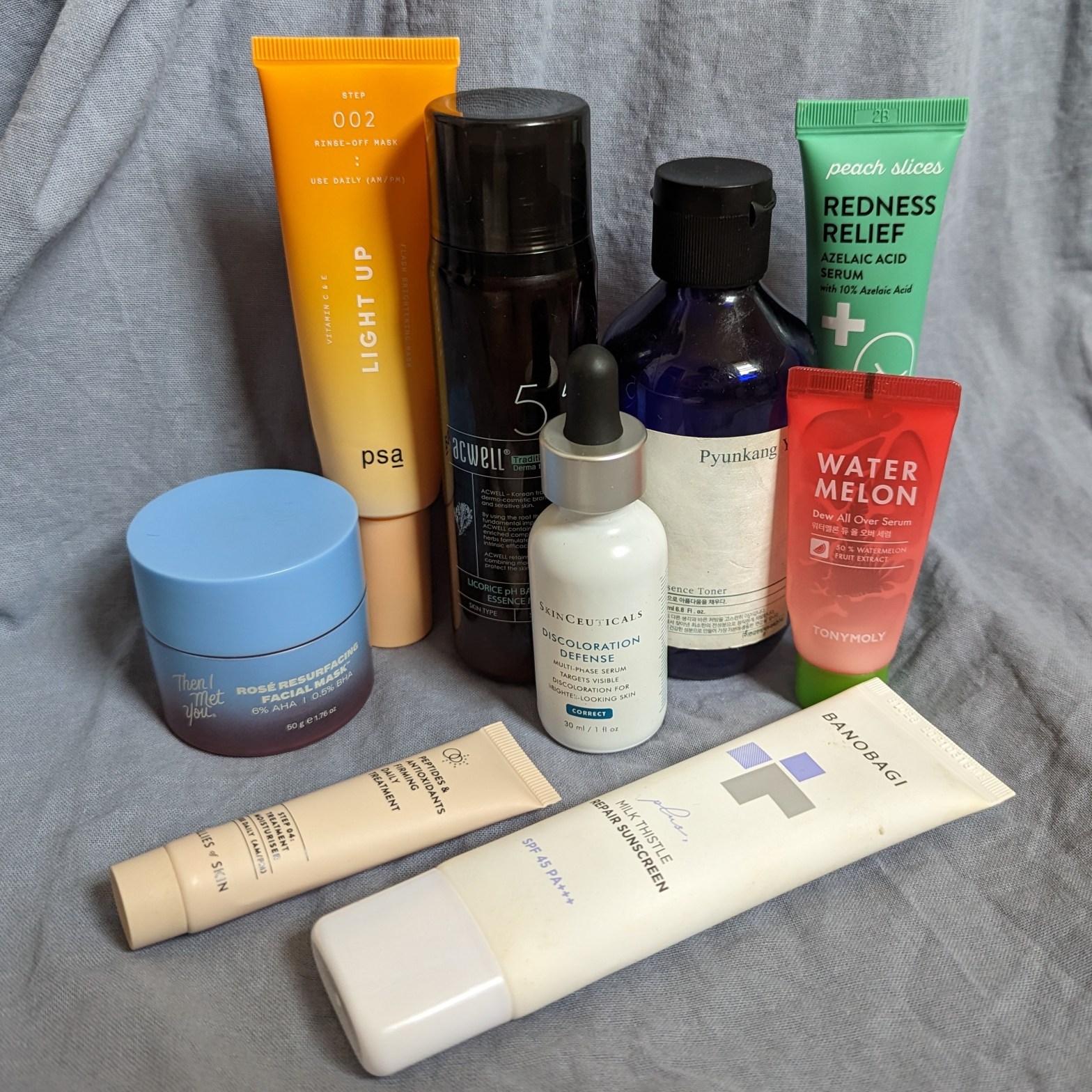
🌹 Then I Met You Rosé Resurfacing Facial Mask

On my tour of all of the competitors to the infamous The Ordinary AHA/BHA mask, I had to try Then I Met You’s RosΓ© Resurfacing Facial Mask. This has 6% AHA (lactic and glycolic acids) and .5% salicylic acid. The gimmick here is in the rosΓ©/rose — grape juice extract and resveratrol to mimic rosΓ© wine, and literal rose flower petals, as well. I find this to be a bit more irritating than the Peach & Lily one, which is my usual go-to. This is likely because it’s really just about exfoliation, with very little other ingredients to make it soothing. It’s unfortunate, because for the price I was definitely expecting and hoping for more. But hey — it did work. Masks like this are great for looking fresh-faced afterwards, assuming your skin can handle the formula.
Opened: November
Price: $56 USD / 50 g
Rating: 6/10

πŸ’‘ PSA Light Up Vitamin C & E Flash Brightening Mask

I usually go in for exfoliating or moisturizing wash-off masks, but PSA Light Up Vitamin C & E Flash Brightening Mask caught my eye in November so here we are. This mask has officially gotten me into wearing a mask while showering (which I don’t do that often — more of a bath person, as long-time readers will know and I don’t always remember, ergo why this has taken 6 months to empty). The packaging on this is absolutely the worst. Pick a lane, PSA: tube or pump, not both. I just unscrewed it to dispense like a tube. This tastes atrocious, which is the problem with using it in the shower, but it does have pretty decent immediate effects. The effect is transient, but it’s a great way to get into 11% ascorbic acid. If you go for this, get it during a BOGO month!
Opened: November
Price: $43 USD / 50 mL
Rating: 7/10

Essences

🌱 Pyunkang Yul Essence Toner

Pyunkang Yul (PKY) is an inexpensive brand that grew out of a clinic in Korea, and the Essence Toner was one of the products that put it on the map. It’s less popular now, but there was a time when it seemed like just about every k-beauty afficionado cycled it through their routine. Like other PKY products, this has a simple ingredients list focused around traditional Asian medicine ingredients — in this case astragalus membranaceus root extract. This essence toner is a bit of a shortcut for glass skin, as a few layers of it makes the skin look and feel hydrated. That said, I wouldn’t recommend this for the seven skins method, and oilier skin types might find it a bit heavy. For my part, I didn’t feel that it was as deeply hydrating as it could have or should have been, and by the time I emptied it I was very ready to move on to other things.
Opened: December
Price: $18 USD / 200 mL
Rating: 8/10

πŸ’¦ Acwell Licorice pH Balancing Essence Mist

I like to get a fair bit of my k-beauty from SokoGlam, and I was able to pick up their collaboration with Acwell, the Acwell Licorice pH Balancing Essence Mist, through its rewards program. I’ve gotten into mists as a way to keep my skin damp between steps, especially because in Colorado I find that my skincare can dry down FAST. As the name suggests, this uses licorice for its brightening effects, but also includes goodies like saccharomyces ferment filtrate, beta-glucan, royal jelly and more. I’ve found that this mister, while it seems initially meh, can dispense a decent spray if you just leave it depressed longer. Thought his has some citrus fruit extracts and bergamot essential oil, I did find this mist to be calming and hydrating.
Opened: January
Price: $24 USD / 100 mL
Rating: 9/10

Serums

πŸ”΅ SkinCeuticals Discoloration Defense

Full disclosure: my SkinCeuticals Discoloration Defense was discolored when I got it, so this may not be the best review. That’s right, this sucker can oxidize, so if you, like me, got it from your spa after they stored it on a shelf for a while, you may not have the best results. (This is why I have also not purchased the famed Vitamin C yet — I have tried a sample and it was definitively brown.) I’m blessed with a bit of a melasma mustache, so I was hoping that the niacinamide, tranexamic acid and kojic acid in this would do some good. I’ve tried niacinamide and tranexamic acid, of course, but kojic acid is a bit harder to find — it’s a tyrosinase inhibitor, like hydroquinone, but without the need to pause usage. I do feel that it’s lightened a skosh, but not nearly as much as I would have hoped for the price point. Again, hard to tell if it would have done better without the oxidization, but it stands to reason it would have been. The biggest issue I had with this is that, because of the oxidization, it gave me a bit of the “Rudy Giuliani drips”, which is extremely unaesthetic. No one wants to be scrubbing brown product out of their hairline. To avoid this, I cocktailed a drop or two with various other serums.
Opened: February
Price: $108 USD / 30 mL
Rating: 7/10

πŸ‰ TonyMoly Watermelon Dew All Over Serum

If you love the smell of watermelon candy, you need the TonyMoly Watermelon Dew All Over Serum in your life. While I initially thought this was for face (and it is!) it’s also for body, which makes the price per mL and strong fragrance make a bit more sense. This has 50% watermelon fruit extract, as well as meadowfoam seed oil, centella extract, and aloe extract. I could definitely see repurchasing this for body use if I lived in a more humid climate, and if even unscented lotion on my legs didn’t bring my pups running to lick it all off. As the serum name suggests, it’s definitely lightweight, and while the fragrance is a bit much when applied to the face, it’s not as offputting on the body. I will note, however, that I was only able to use it in about five face routines before downgrading because, even as a lover of watermelon candy who doesn’t mind fragrance, it was overpowering.
Opened: this month
Price: $15 USD / 120 mL; shown in a sample size
Rating: 8/10

πŸ‘ Peach Slices Redness Relief Azelaic Acid Serum

Peach Slices Redness Relief Azelaic Acid Serum is a standby in our house, taking over for the Paula’s Choice booster due to accessibility, both in price and in ordering. This has 10% azelaic acid, which my husband loves for his rosacea. He also, if I do say so myself, wakes up looking darn good the morning after he uses it, so it’s got other exfoliating, calming benefits beyond that particular usage. This has panthenol, mugwort extract and centella extract, and more of a serum texture than the Paula’s Choice version.
Opened: January
Price: $20 USD / 30 mL
Rating: 10/10

Creams

🧬 Allies of Skin Peptides & Antioxidants Firming Daily Treatment

The Allies of Skin Peptides & Antioxidants Firming Daily Treatment is, in my opinion, horrifically expensive, and that’s the only reason it’s not getting a 10/10. That said, as I stated in April’s review, I could see this being the moisturizer I use when I’m done experimenting, and spending $130 for one product rather than most of a routine doesn’t make me cringe. This is a lovely, calming, mid-heavy weight cream, and the ingredients list is a real “who’s who” of cool stuff: Teprenone complex (stabilizes telomeres), multiple peptides, niacinamide, caffeine and other antioxidants, lactobacillus ferment, honey, ceramide precursors and more. A little of this goes a long way, and I suppose if I buy it only in BOGO months (which they have surprisingly often), I suppose some day I’ll be able to stomach the price per mL — my usual goal is around $1 per mL, and this is notably more than four times that.
Opened: April
Price: $129 USD / 30 mL; shown in a sample size
Rating: 9/10

πŸ₯› Banobagi Milk Thistle Repair Sunscreen

I remember not super loving the Banobagi Milk Thistle Repair Sunscreen the last time I tried it (got it on BOGO, because apparently that’s the theme of this empties review). I am singing a different tune now. This is a moisturizing sunscreen that I have never had an issue with pilling, and it leaves the skin feeling lovely. Milk thistle, also known as silymarin, is a powerful antioxidant, which, of course, is a great thing to have in a sunscreen. The moisturizing properties come from the inclusion of both dimethicone and various seed oils, and that might also be why it avoids the “what moisturizer can I use under this” dance — though I didn’t even always need a moisturizer under this. In addition, this has madecassoside, sea buckthorn extract and four peptides. This is an SPF 45+ PA+++, but uses modern chemical filters, so the protection seems to be quite stable.
Opened: February
Price: $18 USD / 50 mL
Rating: 10/10

April Openeds Reviews

It feels a bit like I wound up with a whole new routine this month, but given how I’ve renewed my skincare practice with new vigor, I suppose that makes sense. My skin has gotten even thirstier than usual with the shift towards spring in Colorado (though leaves are only hitting the trees now, in May), so many of the products I opened this month were all about restoring hydration and sealing it in to my dry, dehydrated skin.

Essences and Toners

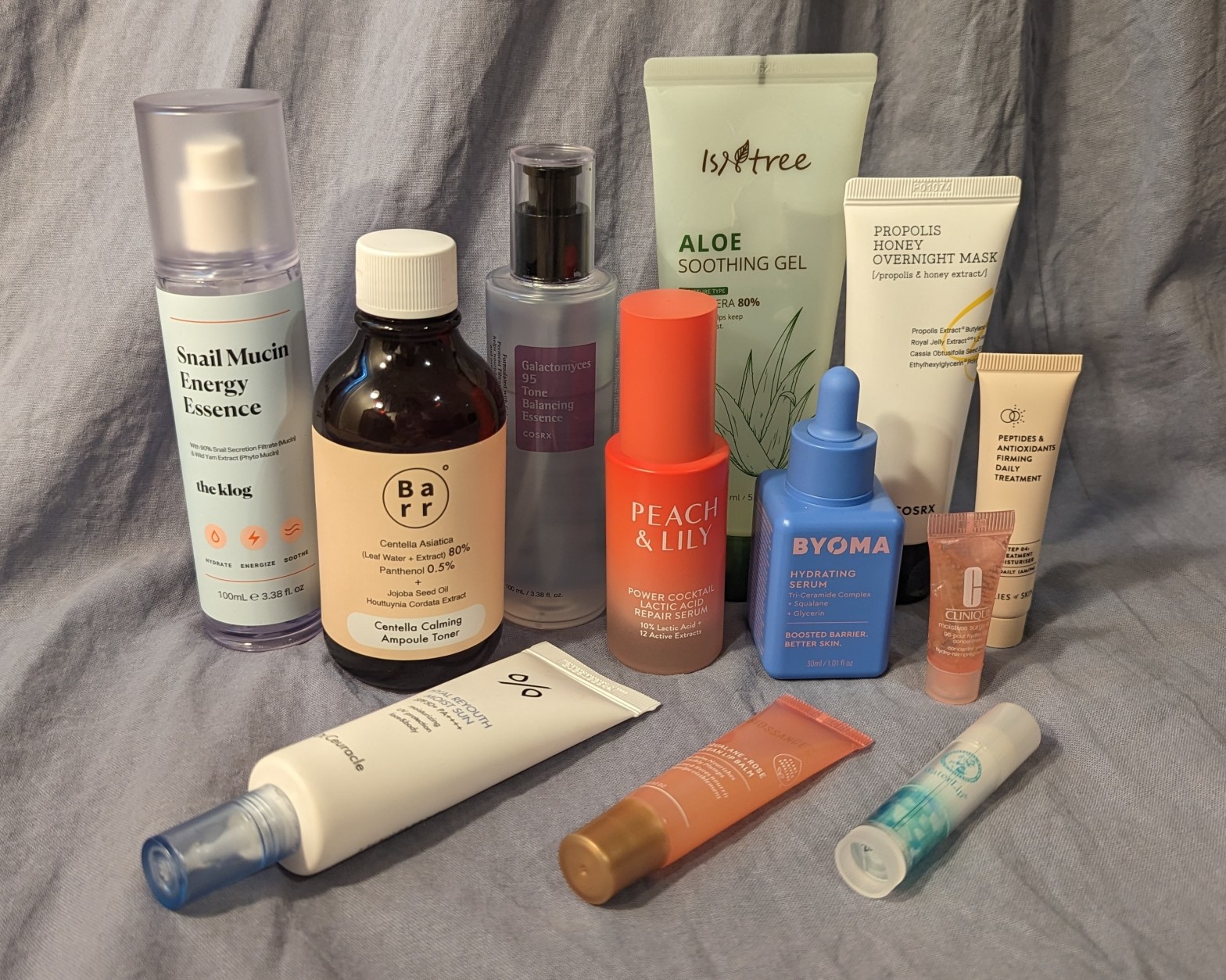
πŸƒ Barr Centella Calming Ampoule Toner

The Barr Centella Calming Ampoule Toner is the third product from Barr’s calming line I’ve tried (the first being the moisturizer, currently in use, and then the essence, emptied in April). Like the other products in the line, this leans into calming with centella (water and extract), panthenol, ceramide NP, heart leaf and jojoba seed oil. I don’t find it to be particularly hydrating, which was a problem I also experienced with the essence — this is likely due to the willow bark extract balancing the humectants and oils in the formulation. But it’s not stripping, and I don’t mind layering on some extra calming power.
Price: $22 USD / 200 mL

🍢 Cosrx Galactomyces 95 Tone Balancing Essence

My adventures in galactomyces essences continue with the Cosrx Galactomyces 95 Tone Balancing Essence. I’ve tried all of the first essence dupes for SK-II at this point, and my favorite has been (spoiler alert) the Missha, but I figured I was remiss if I didn’t try this. The Cosrx essence … is not a dupe. Most importantly, it’s not a first treatment essence, and that’s where the lack of dupe-ness comes from. This doesn’t have the light, watery texture of first treatment essences, but rather than thickness of a classic essence. It dries down sticky and almost feels drying on my skin, rather than deeply hydrating like first essences do. It’s too soon to say how well it works for brightening, or for pore control, though with the addition of niacinamide in the formula, I’m hopeful.
Price: $24 USD / 150 mL

🐌 The Klog Snail Mucin Energy Essence

I finished Cosrx’s cult classic snail essence last month, so it felt appropriate to immediately follow it with The Klog Snail Mucin Energy Essence (do y’all want a Face Off on the two? Let me know! I can make that happen). This essence has snail mucin at 90% — while snail might sound gross, it’s a great hydrating, healing and anti-aging ingredient, and this essence notably lacks the stringy texture that characterizes snail. In addition, this has yam root extract, which is considered to be the vegan snail mucin alternative. Yam root is making a bit of a splash in k-beauty at the moment because it does have similar hydrating and healing benefits to snail, all while, well, being vegan. This has slightly more weight to it than the Cosrx, in my opinion, but I’m excited to see how yam root works for me.
Price: $17 USD / 100 mL

Serums

πŸ’§ Byoma Hydrating Serum

Byoma is a relatively new brand making some waves with their cute packaging and ceramide-centric products, and their Hydrating Serum is one of several serums they arrived on the market with. Despite its name, this is not what I think of as a typical hydrating serum, with a watery or gel-like texture, and strong emphasis on various humectants. Instead, this is really what I think of as a skin-barrier supportive serum — it even has the skin barrier trifecta of ceramides, cholesterol and fatty acids. This includes squalane, cholesterol, ceramide NP and phytosphingosine (a ceramide precursor), as well as glycerin, lactic acid at hydrating levels, and vitamin e. It’s a creamy serum that doesn’t add any heaviness to the skin.
Price: $16 USD / 30 mL

🍹 Peach & Lily Power Cocktail Lactic Acid Repair Serum

The Peach & Lily Power Cocktail Lactic Acid Repair Serum is a great, gently exfoliating serum. It has 10% lactic acid, which is enough to exfoliate but also hydrate, and in the case of my skin make it fine for near-daily use. In addition, this boasts ginseng root extract, green tea extract, various fermented extracts and other nice extracts. To amplify lactic acid’s hydrating qualities, this includes glycerin, polyglutamic acid and multiple weights of hyaluronic acid. To offset the exfoliation’s potential irritation, it has ceramide NP and several peptides — formulated to not denature. This one has come up twice on Ulta’s 21 Days of Beauty, so it’s probably worth holding out for that rather than paying full price (that’s what I did).
Price: $51 USD / 30 mL

Creams, Moisturizers & Sleeping Masks

🌡 Isntree Aloe Soothing Gel – Moisture Type

The Isntree Aloe Soothing Gel (and the rest of Isntree) has undergone a redesign since I bought it, but this is the Moisture Type. Though the Fresh Type is pretty much pure aloe, the Moisture Type is 80% aloe, and a lot more besides: centella, green tea and licorice root extracts, multiple weights of hyaluronic acid, polyglutamic acid and more. I had originally purchased this to use with my NuFace, which I still do, but I’ve also taken to using it as a serum layer within my routine, in part because the toner and essence above have me longing for more hydration.
Price: $14 USD / 150 mL

πŸ‘ Clinique Moisture Surge Eye 96-Hour Hydro-Filler Concentrate

The Clinique Moisture Surge Eye 96-Hour Hydro-Filler Concentrate is definitely a bit of “skintertainment”, as Youtuber Kelly Driscoll would call it. This has a lightweight gel texture, with little balls that burst on your skin during application. These balls are encapsulated antioxidants like green tea leaf extract, algae extract, caffeine and more. This also includes niacinamide and cholesterol for supporting the skin barrier, as well as acetyl hexapeptide-8 and palmitoyl hexapeptide-12 for anti-aging. This does include some artificial colors in it, ergo its pretty pink hue.
Price: $37 USD / 15 mL; shown in a sample size

🧬 Allies of Skin Peptides & Antioxidants Firming Daily Treatment

Allies of Skin Peptides & Antioxidants Firming Daily Treatment is the sort of moisturizer I could see myself “settling down with” someday, when I stop experimenting with skincare and don’t cringe at the thought of $130 for 30 mL of product. (In Allies of Skin’s defense, they DO run frequent BOGO sales — note to future self.) Allies of Skin claims this is a 5-in-1, and to look at the ingredient list I do believe it. This has Teprenone complex, which ostensibly stabilizes telomeres (aka helps pause the internal clock our cells have) while generally improving cell function. It also has a variety of peptides, including palmitoyl tripeptide-5 for promoting collagen production and reducing TEWL, and palmitoyl tripeptide-8 for redness reduction. On the antioxidant front, this includes niacinamide, caffeine vitamin c derivative tetrahexyldecyl ascorbate (THD ascorbate), astaxanthin, glutathione and a variety of extracts. Other fun, skin barrier-supportive ingredients are lactobacillus ferment, honey, ceramide NP, sphingolipids, phospholipids and various nice oils. A little goes a long way with this, though it is a very nourishing, nearly-heavy cream.
Price: $129 USD / 30 mL; shown in a sample size

🐝 Cosrx Full Fit Propolis Honey Overnight Mask

The Cosrx Full Fit Propolis Honey Overnight Mask has been overdue making its way into my routine, given my love of Cosrx, propolis, and sleeping masks. This has 70% of the “bee trifecta” — propolis extract, honey extract and royal jelly extract. I love this combination for the glow it gives, as well as lightweight healing and moisturization. In addition, this has panthenol and allantoin for soothing, and glycerin and sodium hyaluronate. It’s a lightweight gel that I use as my last step in the evening, but they recommend also using it as an AM moisturizer, or as a wash-off mask — neither of which I’ve tried, but I probably will! I anticipate it will feel refreshing as we head into summer in Colorado.
Price: $18 USD / 60 mL

Lip Care

🌹 Biossance Squalane + Rose Vegan Lip Balm

This is my third time opening a Biossance Squalane + Rose Vegan Lip Balm and I like it the best this time — because now they have it in a tube, rather than a tub! This is a fairly sticky-textured, occlusive lip balm, so having to dig into a tub was messy and undesirable. As part of the repackaging, they also reformulated. I don’t recall what the formula was previously, but worthwhile callouts in the new iteration are wakame algae, ceramide NP, THD ascorbate (the vitamin c derivative), rose flower wax (whatever that is), and nice oils like squalane, grape seed oil and jojoba.
Price: $16 USD / 15 g

πŸ’‹ Rohto Mentholatum Water Lip Balm SPF 20 PA++

I go through a lot of Rohto Mentholatum’s lip spfs, in part because they’re so wearable and in part because, frankly, actually emptying a lip balm rather than losing it is a serious accomplishment. The (unfragranced) Water Lip Balm, which is SPF 20 PA++, is my latest exploration with them. This is a legitimately nice lip balm which sticks around and makes the lips feel smooth and soft, and protects from UV without any funky sunscreen taste or white cast. It uses new generation chemical filters, and has a near who’s who of occlusive lip ingredients: vaseline, lanolin, mineral oil and microcrystalline wax. It also has two forms of hyaluronic acid, as well as collagen, aloe extract, squalane and honey.
Price: $4 USD / tube

Other

🧼 Rhonda Allison Foaming Peptide Cleanser

I put off opening the Rhonda Allison Foaming Peptide Cleanser for quite a while (I received it for Christmas in … 2021?) because of the “foaming” in its name (and, in fairness, because of how slowly I somehow go through cleansers). I should not have — this is not foaming, and not stripping at all. Indeed, it’s really more of a milk cleanser, which is what they claim on their website, and leaves the skin feeling very soft. This literally does have milk in it — goat milk and yogurt extract — as well as hydrolyzed protein, which is where the peptide claim presumably comes from. I’m definitely not disappointed!
Price: $14.50 USD / 30 mL (not pictured because, frankly, I forgot to grab it)

β˜€οΈ Dr. Ceuracle Hyal Reyouth Moist Sun

I received the Dr. Ceuracle Hyal Reyouth Moist Sun for free through the YesStyle Influencer program in exchange for a review — which this is not (I still need to write it and post to Instagram, oops). The first few times I used this, I hated it. It simultaneously felt drying and heavy, which is a pretty unexpected combination. This also has a fragrance to it which gives off “oh yeah, I’m putting on a sunscreen now” vibes. In this sunscreen’s defense, however, it’s incredibly ligthweight and liquidy (the applicator helps control it), is chock-full of various weights of hyaluronic acid, and uses the newer generation chemical filters. I’ve found ways to make it work for me now — mostly by significantly cutting down my AM routine while keeping a heavy moisturizer, but I actually prefer it as a body sunscreen, where it really seems to shine because it feels weightless.
Price: $19 USD / 50 mL

April Empties Reviews

It feels like I was back to my old tricks in April, with over 10 empties. You would think that would mean a complete routine overhaul, but my routine is so long that you would be wrong. That said, while I spent April focusing on getting back into skincare (sometimes work wears me down, and phone it in a bit), I also didn’t do all my steps all the time — instead, I made a point of mixing and matching to suit how my skin and I were feeling on any given morning or evening.

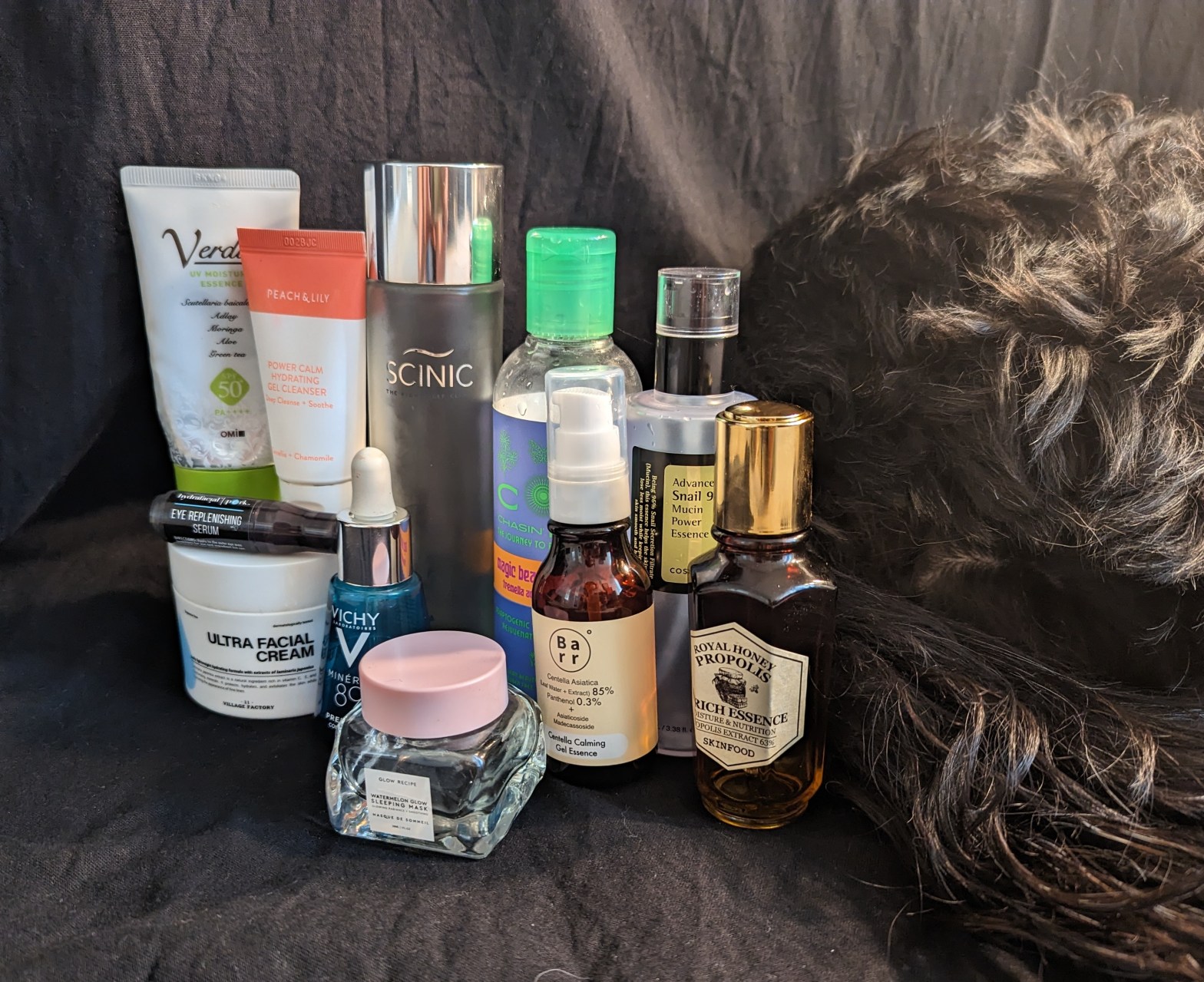
Also — I hope you like the borderdoodle bottom photobomb. I had a whole two products placed before Kirsten decided the banging of roofers stressed her out too much and she flopped down and would not be budged.

Toners and Essences

🍢 Scinic First Treatment Essence

The Scinic First Treatment Essence concludes my tour of the SK-II dupes (outside of Cosrx which, spoiler alert, very much not a dupe). I swear by first treatment essences (specifically with galactomyces) for hydration, pore-size reduction, and just general brightening. They’re a can’t-miss for me. The Scinic didn’t quite add up to what I love in a galactomyces first treatment essence, unfortunately — I feel like I bombed through this in part because I needed two layers to really get that hydration. Good thing that it’s really the cheapest dupe option out there. I also didn’t notice as much pore management from this. Could be that I’m 35 now, could be the product, but I’m going to go back to my tried-and-true Missha, which thankfully runs frequent sales.
Opened: February
Price: $20 USD / 150 mL
Rating: 7/10

πŸ„ Chasin’ Rabbits Magic Beauty Shroom

Call me a sucker for marketing, because I couldn’t not try the Chasin’ Rabbits Magic Beauty Shroom. The shroom in here is not the traditionally magical kind (IYKYK), but rather tremella, aka snow fungus, which is really having its moment due to its hydrating and antioxidant properties. I used this as a toner (it would function as an essence, too), layers up well, though there’s enough body to it you likely wouldn’t want to use it as your only toner for the seven skins method. My skin definitely felt hydrated with it, though it was not as deeply hydrating as some of the other toners I love. I’d give it that final, extra point if it had that deeply hydrating feeling — which honestly might be a function of its texture more than anything else.
Opened: January
Price: $25 USD / 200 mL
Rating: 9/10

🐌 Cosrx Advanced Snail 96 Mucin Power Essence

The Cosrx Advanced Snail 96 Mucin Power Essence is a lot of folks’ holy grail, and an introduction for many to the joys of snail. Snail is a great hydrating, skin soothing and wound healing ingredient (if you’re not allergic to it), and this essence is one of the cheapest ways to get it into your skincare routine. I found that this took three pumps to cover face, neck and chest, and while it did have some snail stringiness, it wasn’t as bad as, say, the Cosrx Advanced Snail All-In-One Cream. While I don’t mind the stringiness one way or the other, I will say that, much like the shroom, this might be one where I found it to be less hydrating than the Peach Slices Snail Rescue Blemish Busting Toner, which I do find to be quite hydrating. Otherwise, I did indeed see all the classic benefits of snail with it, like faster healing on blemishes, and keeping my skin more protected against the barrage of winter.
Opened: December
Price: $25 USD / 100 mL
Rating: 9/10

Serums

πŸ’§ Vichy Mineral 89 Prebiotic Face Serum

I’ve been sleeping on Vichy for a while, despite the insistence of the Skincare Fanatics Modmins team, but I finally took the plunge into their product line with the Mineral 89 Prebiotic Face Serum. Vichy is known for its thermal water, which has high concentrations of 15 different minerals that are good for the skin. In addition, this has niacinamide and postbiotics (but I guess they decided prebioitics sounded more fun). This has a nice milkiness, and didn’t give me the feeling of dryness I sometimes get with hyaluronic acid serums, nor add any tackiness or weight, so it was usable AM and PM.
Opened: February
Price: $35 USD / 30 mL
Rating: 9/10

πŸƒ Barr Centella Calming Gel Essence

The Barr Centella Calming Gel Essence is an essence in that it has a lot of centella, but it’s very much a gel serum — to the point that when there was 1/4 left, it was hard to dispense with the pump, and I had to flip the bottle upside down and tap it out. This has 85% cica leaf water and extract, with additional bioactive compounds madecassoside and asiaticoside. In addition, this has panthenol, ceramide NP and heartleaf extract. I was hoping this would be more hydrating, but it really wasn’t, which shouldn’t be a surprise given the willow bark extract. That said, this isn’t stripping, and I suspect that acne-prone skin types in search of some daily calming would really enjoy this. As it was, it didn’t do anything noticeable for my skin one way or the other.
Opened: February
Price: $18 USD / 60 mL
Rating: 7/10

🐝 Skinfood Royal Honey Propolis Enrich Essence

This is my second time emptying the Skinfood Royal Honey Propolis Enrich Essence — another essence that’s actually a serum. This has what I call the “bee trifecta” of royal jelly, honey and propolis. This makes it moisturizing, healing and glow-inducing, which are all things I am here for in my skincare routines. Additional nice-to-haves here are the beta glucan and sodium hyaluronate for hydration, and lactobacillus and saccharomyces for skin barrier goodness. I pearl clutch a bit every time at the price, since I’m usually a $30 per serum person, but given that this is 50 mL and it’s one of the more available propolis serums in the U.S. (the other one being Cosrx’s ampoule, which is also available at Ulta), it’s a great option for people of any skin type.
Opened: February
Price: $39 USD / 50 mL
Rating: 10/10

Last Steps

πŸ‰ Glow Recipe Watermelon Glow Sleeping Mask

The Glow Recipe Watermelon Glow Sleeping Mask is one of those sleeping masks that is definitely intended to use over a moisturizer. It has a lightweight gel texture that goes on in a nice, thin layer that seems to disappear … until the morning, when it’ll make your AM layer pill unless you give it a good rinse off, at which point it seems to suck in all the water and become positively thick. Every time I forgot to rinse in the morning, I regretted it. I’m not sure if this was resolved in the reformulation/rename to its new Watermelon Glow AHA Night Treatment status. Given that this has lactic acid and glycolic acid, and should not be considered a replacement for a moisturizer, I support its rename, generally — though I will note that it doesn’t seem as exfoliating as you might think, and in my experience was fine for daily use, even layered over retinal or another exfoliant. If you’ve tried this version and the new one, I’d be interesting in hearing what you think!
Opened: January
Price: $40 USD / 60 mL; shown in a 30 mL travel size
Rating: 8/10

πŸ”΅ Village 11 Factory Ultra Facial Cream

I keep seeing Village 11 around, but didn’t try it till the the Village 11 Factory Ultra Facial Cream was an option through the YesStyle influencer Program in exchange for a review (this is not that review). This one definitely got me excited because of its ingredient list: laminaria japonica extract, the hero ingredient, is a type of brown algae shown to give great antioxidant, anti-aging and moisturizing benefits; it also has tranexamic acid and licorice root extract for brightening, green tea and milk thistle (aka silymarin) extracts for additional antioxidant support, and centella and heartleaf extracts for calming. I found that more than a dab of this wound up being too much, despite its lightweight nature. It leaves a bit of an emollient, dimethicone feel on the skin, so it’s likely great for makeup wearers. The price on it is also impressive, and it lasted me a good while. I didn’t notice any particular changes on my skin, other than the improved skin texture while wearing. I honestly felt bored with it after a while, though — or maybe just constantly picking dog hair out of the big tub got old.
Opened: January
Price: $16 USD / 100 mL
Rating: 8/10

β˜€οΈ OMI Verdio UV Moisture Essence SPF 50+ PA++++

The OMI Verdio UV Moisture Essence SPF 50+ PA++++ has, sadly, been discontinued — a common problem with j-beauty and k-beauty brands is they care so much about delivering the best product they can, with regards to sunscreen, that they seem to reformulate frequently. It’s a crying shame about this one, however, because I hear that the new version isn’t nearly as good for dry skin. This is a j-beauty sunscreen that uses modern chemical filters to get the coverage listed, and while this isn’t water-resistant, I’ve never had an issue with it. Even better, my husband enjoys using it — that’s why it was open for so long. I hear the new gel is great for oily skin, though, and still reasonably priced, so definitely try out the brand if you haven’t yet.
Opened: October
Price: $11 USD / 50 g — discontinued
Rating: 10/10

Other

πŸ‘ Peach & Lily Power Calm Hydrating Gel Cleanser

Don’t be deceived by how long it took me to empty the Peach & Lily Power Calm Hydrating Gel Cleanser travel size, since I definitely used it in its travel capacity. That said, the full-size was one of my first cleansers after getting Seriously Into Skincare, and it did legitimately last me forever. This is one that would make a great AM cleanser for folks who do that, assuming you use the usual pea size amount. For evening, you definitely need to apply with more aplomb, as it can leave some residue afterwards (I would recommend using it as a second step in a double cleanse, though). Beyond its gentleness, there’s not much to say about this cleanser. It doesn’t strip, but it also doesn’t leave any lasting calm or hydration on the skin, except perhaps if your skin is so angry and so dehydrated that any hint of product will do so.
Opened: September
Price: $28 USD / 100 mL; shown in a travel size
Rating: 8/10

πŸ‘ Hydrafacial Eye Replenishing Serum

I occasionally indulge in Hydrafacials, and if you get the eye perk you’ll get the Hydrafacial Eye Replenishing Serum after. This is essentially like a toner for the eyes, with oat kernel, mushroom and arnica extracts, as well as hyaluronic acid. I’ll admit I didn’t notice a difference when using this, though I will say that rollerballs for eye skincare are definitely deserving of their hype — what a nice way to apply, and it feels like it’s depuffing even if it might not actually be doing so.
Opened: January
Price: N/A
Rating: 5/10

Face Off of the Krave Beauty Sunscreens: Beet Shield vs Beet the Sun

If you’re on Skincare Internet, you’re probably at least aware of k-beauty sunscreens. They started to get particularly popular in the U.S. around three years ago. None had as much of a cult following as Krave Beauty’s Beet Shield (though Purito and Klairs sunscreens deserve an honorable mention). This sunscreen was known for its wearability, its beautiful finish, and frequently being out of stock. For my part, it helped me and my husband get into being regular sunscreen wearers, and my fellow modmins at Skincare Fanatics once relentlessly teased me for buying 10 bottles during Black Friday.

It was also known for being the only sunscreen with next generation chemical filters that you could actually buy from a U.S.-based company. (This, later, got them into trouble — but more on that in a moment.) It later also became known as one of the victims of The Great Sunscreen Exodus of early 2021 when independent lab testing found that it did not meet its stated SPF protection (along with Purito, Klairs, and many others — ergo The Great Sunscreen Exodus). I’m not interested in delving into the ethics of all that went down, or how various corners of Skincare Internet might feel about it, nor the history — Krave has done an excellent job of covering that themselves in their Welcome Home post. Rather, this post will be comparing the old Beet Shield with the reformulation, Beet the Sun. Unlike many of the sunscreen reformulations after The Great Sunscreen Exodus, Beet the Sun is, in many ways, the true successor to Beet Shield — but there are some caveats worth noting.

Sunscreen Filters

Beet Shield and Beet the Sun are both chemical sunscreens, meaning they don’t use the often-drying, often-white-casting zinc oxide and titanium dioxide to provide protection. They’re also both broad spectrum, meaning that they provide protection across both UVA and UVB.

While the original Beet Shield was manufactured in Korea, Beet the Sun was manufactured in the United States — and that means very different filters. Much of the world, including the EU, Asia and Australia, allow the usage of newer sunscreen filters, because they have been approved by the various regulatory bodies in those regions. Unfortunately, the U.S. (and Canada) are behind the game. This is an outcome of what goes into obtaining F.D.A. approval for a new drug (which sunscreen filters are considered) and which other folks have addressed at length (one of my favorites being an article last summer by The Atlantic) but to which I will simply say Curse you, Capitalism! Let us have nice things.

Beet Shield

Uvinul A Plus (aka Diethylamino Hydroxybenzoyl Hexyl Benzoate or DHHB) at 3.5%. A UVA filter (320-400 nm) which can be used at percentages up to 10% everywhere but the U.S. and Canada.
Tinosorb S (aka Bis-Ethylhexyloxyphenol Methoxyphenyl Triazine or Bemotrizinol) at 3%. A broad-spectrum filter (so UVA and UVB, or 280-400 nm) which is, of course, available in Europe, Australia and Asia, but not the U.S.
Uvinul T 150 (aka Ethylhexyl Triazone or Octyltriazone) at 2%. A UVB filter approved to use at percentages up to 5% everywhere but — you guessed it — the U.S. and Canada.
Amiloxate (aka Isoamyl p-Methoxycinnamate or Neo Heliopan E1000) is a UVB filter with some UVA coverage (290-340 nm). It is approved at percentages up to 10% in the EU, but not at all, of course, in the U.S.
Parsol SLX (aka Polysilicone-15) is a UVB filter (290-320 nm) which is also approved at percentages up to 10% in most of the world beside the U.S.

Big ups to incidecoder.com for still having the old formulation on their site, and for being such a fount of knowledge as it pertains to pretty much anything ingredient-related. These filters are known for being easy to wear, photostable, non-irritating, and generally Much Nicer than the older generation chemical filters. It is worth noting that while Beet Shield did eventually not meet their SPF 50+ PA++++ claims, that the filters themselves are not at fault — rather, the manufacturers of various Korean sunscreens featured in The Great Exodus didn’t do their due diligence across various dimensions.

Beet The Sun

Homosalate at 10%. A UVB filter (295-315 nm) which is known for being a relatively weak filter, and not very photostable. 10% is the maximum percentage allowed.
Octisalate (aka Ethylhexyl Salicylate or Octyl Salicylate, Octisalate) at 5%, approved at percentages up to 10%. Another weak UVB filter (295-315 nm) typically used to support other chemical formulas. According to Krave Beauty, it also helps with the water-resistance of the formula.
Avobenzone (aka Butyl Methoxydibenzoylmethane) at 3%. It is known for being the only UVA chemical filter (310-400 nm) approved for use in the U.S. It is also known for not being very photostable.
Octocrylene at 3%. It is a UVB filter with some UVA protection and is the most stable of these chemical filters. It is usually used to help stabilize formulas, as well as to increase their water-resistance.

Some of these chemical filters, like avobenzone, have a fair amount of controversy around them, and can be irritating to some. Unfortunately, the fact remains that these and few others are the only chemical sunscreen filters available to the U.S. market. Their lack of photostability is part of why reapplication is so important — Beet the Sun can’t maintain its SPF 40 PA+++ over time without you doing your part, too.

Other Noteworthy Ingredients

True to their names, both Beet Shield and Beet the Sun include beet root extract. On one hand, it’s pretty fun to have a product intended to keep you from turning red leaning heavily on a plant that is doomed to turn you and everything around it red. On the other hand, it’s also a great skincare ingredient. It has some natural moisturizing factors to it, it’s antioxidant (hooray, plants!) and even has some anti-inflammatory benefits.

Past the beet root extract, however, the extra “nice to haves” in these formulas differ dramatically.

Beet Shield

Alcohol, known to be drying to some skin types (including mine) but extremely helpful for providing a good “dry down” on sunscreens, and commonly used for that purpose.
Glycerin, a humectant.
Lithospermum Erythrorhizon Root Extract, a wound healing and anti-inflammatory plant extract. It can also function as a colorant.
Macadamia Ternifolia Seed Oil, an emollient oil with a high oleic acid content.
Allantoin, a soothing, anti-inflammatory ingredient originally from comfrey but usually synthesized.
Epigallocatechin Gallate (aka EGCG), one of the bioactive compounds in green tea. It is a polyphenol, and known to be a great antioxidant, anti-inflammatory and anticarcinogenic ingredient.
Sodium Ascorbyl Phosphate (aka SAP) is a derivative of vitamin C, ergo the “ascorbyl” in the name. This derivative is more stable and less irritating than ascorbic acid, while still providing benefits in terms of antioxidant protection, collagen boosting and skin brightening.
Resveratrol is the polyphenol found in red grapes. It is known for its antioxidant, anti-inflammatory and anticarcinogenic properties.

Given that sunscreen is all about protecting your skin from the sun, Krave Beauty, as well as other k-beauty brands, find it a great step to also include additional antioxidants. Indeed, they are often considered to “boost” your sunscreen, since antioxidants help protect from the oxidative stress that comes from pollution and UV. The original Beet Shield was all about that.

Beet the Sun

Bisabolol, one of the bioactive parts of chamomile, known for its anti-inflammatory and soothing properties.
Hyaluronic Acid, a humectant.
Salix Alba Bark Extract (aka willow bark extract), a plant extract with skin-soothing, antioxidant properties due to the polyphenols and flavonoids in it. It is often considered a gentler version of salicylic acid, though it is more commonly used in formulas to manage sebum than to exfoliate.
Solidago Virgaurea Extract (aka goldenrod extract), a plant extract with skin-conditioning properties, meaning that it can soften and hydrate the skin.
Tocopheryl Acetate, a derivative of vitamin E, ergo the tocopheryl in the name. It is an antioxidant that also shows significant promise as an anti-inflammatory, particularly as it pertains to sun damage itself.

Beet the Sun, on the other hand, seems more concerned with soothing and repairing damage from UV, as well as leaving the condition of the skin better than it started.

User Experience

Ingredients and filters are great and all, but the thing that makes a sunscreen good is whether you will actually want to wear it. After all, if you like your sunscreen well enough to wear it regularly, you’ll reap the rewards, regardless of the filters and other ingredients it might contain.

Price

I don’t believe in expensive sunscreens. Or rather, I do know they exist and have used them, but when you’re supposed to use over 1 mL of sunscreen in every application, some sunscreens can start to feel very expensive very fast. Luckily, neither Beet Shield nor Beet the Sun are particularly expensive: both are $20 for 50 mL, or under 50 cents per application. This is about $5 more than many k-beauty sunscreens on the market right now, though Krave Beauty does offer a subscription for Beet the Sun which knocks the price down to $19. (Prices in USD)

Packaging

The big improvement with Beet the Sun is the packaging. Beet Shield came in a hard, plastic bottle used by many retailers at the time. While this was good for keeping it protected from the sun, it made it impossible to get out all of the sunscreen, and was a real problem for folks with limited mobility. The new Beet the Sun comes in a tube, and while it will attempt to run out quickly if you, say, subject it to changes in elevation (it did not love coming back to Colorado from California last weekend), this is great for ensuring you actually get most of those 50 mLs of product.

Look and Feel

Both Beet Shield and Beet the Sun are lightweight, liquidy sunscreens. Beet the Sun is even more so — as you can see, it started running down my fingers just while swatching. Beet the Sun is whiter, likely because it doesn’t have that extra lithospermum erythrorhizon root extract. Because it is a chemical sunscreen, however, it blends in as seamlessly as Beet Shield did, leaving no white cast on the skin. (Those with darker skin tones may find that the color of the formula fades down more slowly.)

Beet Shield gave a faint dew to the skin, and Beet the Sun does as well, though it is not as dewy as some sunscreens on the market. Both Beet Shield and Beet the Sun require a moisturizer under them, in my opinion — certainly for dry skin, they are not moisturizing enough to be used on their own.

Two fingers of Beet Shield
Two fingers of Beet the Sun

Neither formula feels heavy, and both passed the husband test — my other half has happily been using this for the past few weeks.

Conclusion

If this were a true Face Off, and the original Beet Shield were still available and had been shown to actually meet its SPF 50 PA++++ rating, I must admit that it would come out on top. I love using new generation filters, I think the formulation was really thoughtful, and I wore it on many, many occasions none the worse for wear. Unfortunately, that’s not the world we live in.

That said, Beet the Sun is a great example of a k-beauty-style chemical sunscreen that’s available in the U.S., of which there are very very few — Thank You Farmer and Neogen are the only other ones I’m aware of. It has much of the lovely wearability of k-beauty sunscreens, and is available without having to import from overseas, so if you want to see the fuss without dealing with k-beauty retailers, it’s a great option. However, if you already love k-beauty sunscreens and are getting them shipped to you on the regular, I don’t know that I’d say you have to go out and get this. Notably, it’s a lower SPF value than many chemical sunscreens from Korea, and the U.S. filters can be more irritating.

Remember, the best sunscreen is the one you’ll wear!

March Openeds Reviews

Guess who’s back. Back again. A surprising amount of discontinued and reformulated skincare, that’s what! Great to have some old friends back in my routine, as well as try some new things. And stay tuned for next week, when Beet the Sun and Beet Shield go head-to-head (ish).

Back Again

πŸ’– Krave Beauty Beet the Sun

Krave Beauty’s Beet Shield was my gateway sunscreen, back in the day, making me a daily user, so understandably my husband and I were pretty sad when it went away. But now it’s back, as Beet the Sun! This version is an SPF 40 using, unfortunately, older generation filters — but that’s what happens when you formulate in the U.S. This is a very liquidy, lightweight sunscreen, which is pretty hard to achieve with homosalate, octisalate, avobenzone and octocrylene. Beyond using the older filters, this does have a pretty similar inci list to the old version. Also like the old version, it seems to sell out regularly. More details and comparison to come next week!
Price: $20 USD / 50 mL

πŸ’ Good Days For All C’s The Day

You’ve seen me hyping Good Skin Days C’s The Day — now get ready for me to hype Good Days For All C’s The Day. This is one of the brands from Soko Glam, and it seems that in addition to their reformulation of this particular serum, they also went for a rebrand. The old version was a big favorite of mine: inexpensive and often on sale, a nice middling ascorbic acid percentage (10%), and a bunch of other brighteners (licorice root, niacinamide, camu camu extract). It oxidized pretty quickly, however. That seems to have been solved by the reformulation, and at the same time they got in even more brighteners: an additional 2% ascorbic acid, magnesium ascorbyl phosphate and arbutin. It also has ginseng, white truffle and other extracts.
Price: $26 USD / 30 mL

πŸ’œ By Wishtrend Vitamin A-mazing Bakuchiol Night Cream

By Wishtrend Vitamin A-mazing Bakuchiol Night Cream is not a reformulation, and I hope they don’t reformulate it — I just emptied my first bottle in March and gave it a 10/10, and anticipate rebuying in the future. I always cocktail this with a moisturizer, so it can spread further, but when I do so I also find I can use it nightly. In addition to retinal, this has bakuchiol, niacinamide, palmitoyl tripeptide-8, beta glucan, centella extract and ceramide NP, making it a skin-rebuilding powerhouse. It seems like this isn’t getting nearly as much love as other k-beauty retinals, and I’m a bit surprised by that, as it seems as lovely as Stratia Night Shift, but stronger.
Price: $33 USD / 30g

🟑 Banila Co Clean It Zero Cleansing Balm Nourishing

Banila Co Clean It Zero Cleansing Balm, the original, made me fall in love with cleansing balms, so I had to try a new flavor: nourishing! Notionally, this is the one for dry skin types, though realistically, as a first cleanse, most any skin type/concern should be able to use most any version. From a feel and emulsification aspect, they’re pretty similar — after all, the first four ingredients are the same, and that’s where most of the magic happens. This does feel genuinely more moisturizing, though, likely because unlike the original, this has safflower seed oil, evening primrose oil, sunflower seed oil and squalane. It also includes ginseng berry and root extracts, and royal jelly extracts. While these ingredients aren’t necessarily going to do much when they get rinsed off immediately, it’s always nice to have them, and I find that the moisturizing nature of this cleansing balm can help offset the more stripping nature of a second cleanse. I will note that this does have fragrance added — and I like it.
Price: $24 USD / 100 mL

New To Me

🌠 Allies of Skin Mandelic Pigmentation Corrector Night Serum

I got the Allies of Skin Mandelic Pigmentation Corrector Night Serum as a mini with a larger PSA order, which is good because otherwise I probably Never Would Have Purchased It. Not that it’s not great. It is actually a really thoughtful formulation. I just have heart palpitations at the thought of spending more than $3 per mL of product — indeed, per that math, they gave me over $20 in free product. This seems like a great serum for the sort of person who wants just one: in addition to mandelic acid, this has niacinamide, lactic acid, rosehip seed oil, bakuchiol, salicylic acid, green tea leaf extract, panthenol, resveratrol, ascorbic acid and three peptides. The fact that this can include peptides and acids without the efficacy of either being altered is a real testament to Allies of Skin, and likely a good amount of why it’s so pricey. I find this usable every day, and while there hasn’t been much time to see a difference, I could see why it would, over more time.
Price: $105 USD / 30 mL; shown in a 8 mL mini

πŸ‘ Peach Slices Acne Spot Dots

Out with the old package of pimple patches, in with Peach Slices Acne Spot Dots. I’ve been holding onto these so long, in classic Lisa fashion, that they’ve changed the packaging. But they still are what they are: 30 hydrocolloid patches in 3 sizes, with 15 small ones, 6 normal and 9 large. These are the same thickness throughout, which may be better or worse, depending upon your blemish situation. Given that I was recovering from a pretty epic blemish and trying to keep it protected, I appreciated that upon opening them.
Price: $5 USD / 30 patches

πŸƒ Barr Centella Calming Barrier Cream

Barr is a k-beauty brand that doesn’t get much exposure in the western market, probably because of its limited distribution (though it’s available on the big international k-beauty retailers) and its limited product line (minimalism is part of their ethos). They’re most known for their centella line, from which I’m also using another product. The Centella Calming Barrier Cream is a midweight, hydrating cream, without the heaviness that usually goes along with barrier creams. It uses 64% centella asiatica leaf water, 1% panthenol, 1% squalane and 1% jojoba to do its good work, though there’s also ceramide NP, heartleaf extract and two of the bioactive compounds of centella (madecassoside and asiaticoside) for good measure. This seems like it would be great for use in summer, or for more acne prone skin types that want a non-comedogenic barrier cream.
Price: $20 USD / 80 mL