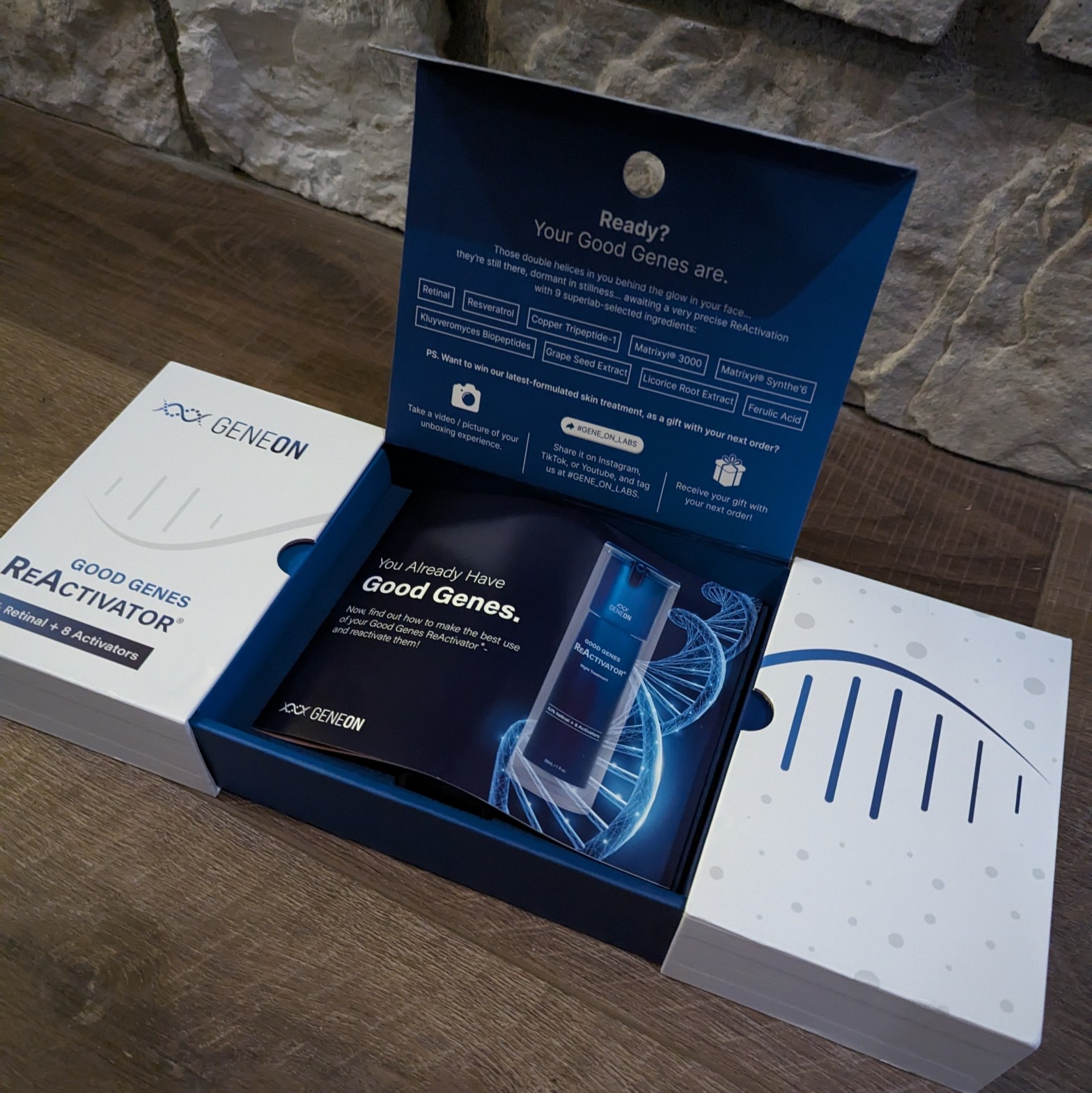
The lovely folks at GeneOn sent me their Good Genes Reactivator at the beginning of the year, and I’ve finally had enough experience with it to review it in detail.
Product Details
As some may know, I’ve moved up from retinol to retinal within the last year or so. Retinal is one step closer to being retinoic acid, the bioavailable thing your skin actually uses, and thus is generally stronger. I’ve thus far been going for relatively low percentages of it so I can maintain my daily or near daily use.
This isn’t just retinal, but also has peptides and resveratrol. Resveratrol is a popular antioxidant, and for good reason. Like antioxidants generally, it helps reduce UV and environmental damage. Resveratrol in particular has been shown to stimulate collagen production, which given its ability to penetrate the skin barrier is extra helpful. On the peptide side, this has 1.5% Matrixyl 3000 and 1% Matrixyl Synthe 6, two blends shown to signal collagen creation, as well as copper tripeptide-1, which has been shown to do the same. Out of left field, it also has 1% Kluyveromyces Biopeptides, which can literally slow down cell apoptosis — aka it can make your cells live longer.
In the name of science, and because I was having eczema on one side of my face when I started, I just used the product on the left side of my face for the first two months. In the last month, I’ve started using it on both sides, because I actually have noticed enough results that I didn’t want to be “lopsided”. What are those results, you ask?
My Results
Unfortunately, it has had no effect (thus far) on the melasma on my upper lip that can give me the dreaded perma-mustache. It has, however, reduced some of the sun damage on my cheeks — not getting rid of freckles, but reducing the splotchiness. I also saw a reduction in redness around my nose, where my seborrheic dermatitis sometimes likes to linger, and it hasn’t itched. This isn’t too surprising, as I have had this experience with other retinol/retinal products, and retinal is known to strengthen the skin.
Retinal and the peptides in this product are known to firm and plump skin — and perhaps the most notable thing about my side-by-side project is that it did indeed. My left cheek started feeling bouncier than my right. This was even backed up by the “husband test”, wherein one evening I forced him to poke both sides of my face, and unbidden he confirmed my own impressions. This, frankly, was what made me decide to start applying to both sides of my face, rather than just continue with the one — ain’t nobody here for being lopsided. I am happy to say that since using it on both sides of my face, my right cheek has caught up to my left.
How I Used
The product recommends using by applying directly to a clean dry face, and following up later with moisturizer after the product has had a chance to dry down. I did not do this. I almost never follow the directions on how to use a product, frankly, mostly because my routine’s too involved. Specifically with retinoids, however, I prefer the “sandwich” method, by which I do my routine and moisturize, then apply retinal, then apply a sleeping mask. I used two pumps per application, not missing neck, decolletage or eye area — I’ve found that with the sandwich method, I can safely use retinal in both areas without misadventures.
I use this nearly every day, which is a function more of a spotty routine adherence, lately, rather than anything intentional. That said, if you are new to retinal or generally sensitive, I strongly recommend not doing that. With this, I started once a week, and gradually increased frequency.
You don’t need to wash your face the morning after using this product (unless that’s a thing you were doing already), but I do recommend sunscreen on general principle — no reason to pony up the cash for this product if you’re not going to protect your results.
 Lisa Loves Skincare