So you want a cica cream. Maybe you have persistent sensitive skin and you want some relief, maybe you’re hoping to tone down some redness from rosacea and inflammation, or maybe you just spent too much time out in the sun. Because of cica’s powerhouse soothing and wound-healing benefits, it can be handy to have a cica cream around for everything from moisturizing to treating bug bites. Cica creams are a great staple to keep on hand in your routine, but there are a lot to choose from. So let’s talk about the two you’re most apt to have heard of (and, full transparency, the only two I’ve tried).
But First — What is Cica?
Cica is the colloquial term for centella asiatica. It’s a plant which is native to southeast Asia, but has become increasingly popular, even getting picked up and used by western brands (La Roche Posay cicaplast anyone?), but if you really want to see brands taking cica to new levels, in my opinion k-beauty is the place to look.
Centella asiatica (sometimes known as gotu kola) is one of those wonderful plants where basically all of it wants to love you and nourish you. Because of this, you may not always see just “centella asiatica extract” on an inci list. You’ll also see centella asiatica leaf and root extracts. As an aside, this leaves me to wonder where the plain old extract comes from and to be honest I don’t know and Google has failed me but it must be the stems? The stuff looks a bit like parsley.
Thanks to the miracles of modern science they’ve also been able to isolate additional biologically active components from cica: madecassoside, madecassic acid, asiaticoside and asiatic acid. Madecassoside is one of the key skin-soothing compounds from centella, with a fabulous wound-healing ability (this is why you’ll find it, and not a centella asiatica extract, on the LRP inci list). Madecassic acid has wound healing and moisturizing properties. Asiaticoside also has wound-healing properties and has some in-vitro studies showing it may help increase collagen synthesis, as does asiatic acid. And, because it seems to be a thing with all plant ingredients, they’re all great antioxidants.
COSRX Pure Fit Cica Cream
COSRX is one of the cult k-beauty brands, and of course has been featured in another Face Off post. The COSRX Pure Fit Cica Cream uses what COSRX calls their Cica-7 complex, in that it includes all seven of the centella asiatica ingredients listed above.
In proper COSRX style, the COSRX Pure Fit Cica Cream also includes pinus pinaster bark extract (sometimes called pycnogenol), which also has anti-inflammatory and anti-oxidant benefit. Additional anti-oxidant properties come from arginine, while allantoin and panthenol basically double down on the wound-healing and skin-soothing.
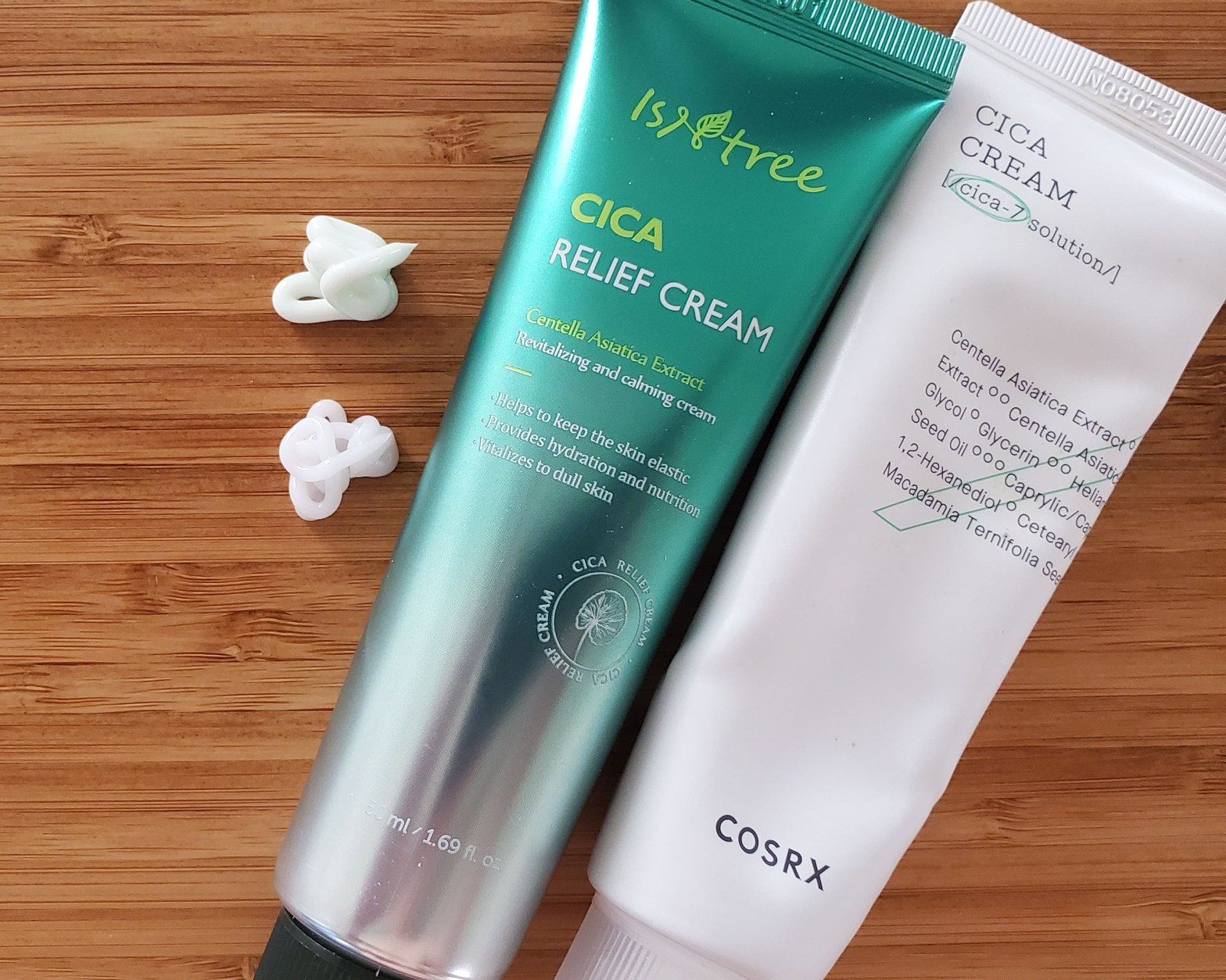
This has what I think of as more of an ointment texture (though less damp), and some would think of as a gel cream. This is visible in the picture — the COSRX Pure Fit Cica Cream is the lower dab of cream. Much of the texture comes from the sunflower and macadamia seed oils, as well as the beeswax, cyclomethicone and dimethicone. I personally find this to pill a bit under sunscreen, though it works well as a buffer layer in the evening under retinol. I also like popping it on any itchy spots — sunburn (darn clothes, why do you move and reveal areas) or bug bites.
Centella Asiatica Extract, Centella Asiatica Leaf Extract, Centella Asiatica Root Extract, Butylene Glycol, Glycerin, Helianthus Annuus (Sunflower) Seed Oil, Caprylic/Capric Triglyceride, 1,2-Hexanediol, Cetearyl Olivate, Sorbitan Olivate, Macadamia Ternifolia Seed Oil, Beeswax, Panthenol, Cetearyl Alcohol, Cyclomethicone, Dimethicone/Vinyl Dimethicone Crosspolymer, Ethylhexylglycerin, Hydroxyethyl Acrylate/Sodium Acryloyldimethyl Taurate Copolymer, Arginine, Allantoin, Carbomer, Water, Pinus Pinaster Bark Extract, Asiaticoside, Asiatic Acid, Madecassic Acid, Madecassoside, Sodium Hyaluronate
Ingredients for Cosrx Pure Fit Cica Cream
Isntree Cica Relief Cream
Isntree is a slightly less popular k-beauty brand, though if you know k-beauty you’ve certainly heard of them (and probably confused them with Innisfree at least once). Their cica cream offering does not include all seven possible cica ingredients, but rather just centella asiatica extract and asiaticoside. Once again, it includes allantoin and panthenol for increased wound-healing and skin-soothing benefits.
Rather than just focusing on cica, the Isntree Cica Relief Cream is packed full of plant extracts and peptides, making it a great well-aging cream. SH-Oligopeptide-1, or EGF, stimulates cell growth and healing. Acetyl Hexapeptide-8 is the “Botox peptide” with wrinkle-smoothing abilities, though it’s not a collagen builder. Palmitoyl Tripeptide-1 is part of Matrixyl 3000, and is one of the few peptides for whom the “this is broken-down collagen so it makes the skin want to create more collagen to replace it” logic holds up. And last among the peptides is Copper Tripeptide-1, found in seemingly any k-beauty product that includes peptides, and is shown to actually have similar effects to cica in terms of wound-healing, anti-inflammatory and antioxidant effects. Edelweiss, neem, eggplant, turmeric and holy basil extracts soften the skin, heal the skin and provide antioxidant benefits.
This is a more typical lotion texture, and is green in color (visible in the picture — Isntree is the upper dab of cream), making it really convenient if one of the things you’re hoping to treat with cica is the persistent redness of sensitivity. I find that it wears really well under any sunscreen.
Water, Centella Asiatica Extract, Dipropylene Glycol, Caprylic/Capric Triglyceride, Glycerin, Hydrogenated Polydecene, Cetearyl Alcohol, Beeswax, Coco-Caprylate/Caprate, 1,2-Hexanediol, Cetearyl Olivate, Glyceryl Stearate, Leontopodium Alpinum Callus Culture Extract, Melia Azadirachta Leaf Extract, Melia Azadirachta Flower Extract, Coccinia Indica Fruit Extract, Amber Powder, Solanum Melongena (Eggplant) Fruit Extract, Curcuma Longa (Turmeric) Root Extract, Ocimum Sanctum Leaf Extract, Corallina Officinalis Extract, Hydrogenated Lecithin, Glyceryl Caprylate, Moringa Oleifera Seed Oil, Asiaticoside, SH-Oligopeptide-1, Acetyl Hexapeptide-8, Palmitoyl Tripeptide-1, Copper Tripeptide-1, Phosphatidylcholine, Panthenol, Allantoin, Palmitic Acid, Cetearyl Glucoside, Hydroxyethyl Acrylate/Sodium Acryloyldimethyl Taurate Copolymer, Adenosine, Xanthan Gum, C12-16 Alcohols, Microcrystalline Cellulose, Cellulose Gum, Dextrin, Sorbitan Olivate, Butylene Glycol, Ethylhexylglycerin
Ingredients for Isntree Cica Relief Cream
The Face Off: When To Use Which
Alright, so that’s the breakdown of inci list and texture, but if you’re still debating, what should you use to get that cica fix?
What you’ll get from both: a light, skin-soothing cream. If you’re dealing with sensitivity and inflammation from basically any source, cica’s an ingredient that needs to be in your arsenal. With consistent use over time you’ll also fight some of the stresses of aging (boo oxidative stress, yay antioxidants). If all you need is a quick fix for occasional irritation, they’ll calm that down too no problem.
What you’ll get from COSRX Pure Fit Cica Cream: a simple cream that will throw every single power of cica wherever you apply it, without introducing any other possible skin-sensitizers
What you’ll get from Isntree Cica Relief Cream: a light cream that goes just a little bit further by providing peptides and more anti-oxidants for additional well-aging and skin-softening benefits.
So which one should you pick? If you’re me, the clear winner is the Isntree Cica Relief Cream. I love the texture and how it feels on my skin, as well as the green tint which calms down redness. But then, I want it as a well-aging day cream for sensitive skin. The COSRX Pure Fit Cica Cream works well as a spot-treatment for irritation, and it could be that their “Intense” version, which I have yet to try, could have better moisturizing capabilities without any pilling.
 Lisa Loves Skincare
2 thoughts on “Face Off of the Cica Creams: COSRX vs Isntree”